Showing posts with label 21C SKills. Show all posts

Tuesday, 29 January 2019

Learning environments - SPACE AND TIME (Part 1/9)

How does the learning environment enhance Creativity?

The theory and practice of Teaching for Artistic Behaviour (TAB) is based on the following 3 beliefs: 
  • What do artists do? 
  • The child is the artist. 
  • The classroom is the child's studio. 

When you look around your classroom, what do you see?
Put yourself in the shoes of your students and examine the walls - how do they make you feel? are they helpful, inspirational, over-stimulating?

Examine the workspaces/centres - are these inviting, exciting, confusing? Would you know what to do, how to start or clean up? Can you find what you need? Is the lay out clear or confusing?

Furthermore, put yourself in the shoes of someone who is shy or timid, exuberant, easily overstimulated, reliant or independent. Now how does your room support their learning styles?

And how can our classroom - the child's studio - enhance Creative Thinking


Continuing with my literature review of
Lai, E. R., Yarbro, J., DiCerbo, K., & de Geest, E. (2018). Skills for Today: What We Know about Teaching and Assessing Creativity. London: Pearson.


LEARNING ENVIRONMENTS 
Davies et al. (2013) identified the following 9 environmental factors as supporting the development of creative skills in students: 
  • flexible use of space and time (1/9)
  • availability of appropriate materials (2/9)
  • working outside the classroom/school (3/9)
  • playful or games-based approaches with a degree of learner autonomy (4/9)
  • respectful relationships between teachers and learners (5/9)
  • opportunities for peer collaboration (6/9)
  • partnerships with outside agencies (7/9)
  • awareness of learners’ needs (8/9)
  • and non-prescriptive planning (9/9)

FLEXIBLE USE OF SPACE AND TIME (1/9)
Having flexible use of space within the classroom or studio can promote students’ creativity and imagination to support the growth of ideas (Bancroft, Fawcett, & Hay, 2008; Jeffrey, 2006, cited in Davies et al., 2013).
For example, not using specifically themed role-play areas and props in early-year settings gave more freedom for the students’ imagination (Bancroft et al., 2008).
Flexible seating options or learning spaces in classrooms has gained a lot of attention from teachers in recent times.

This news article on making a change can be accessed here (source of image above)
goodbye-desks-hastings-classrooms-add-flexible-learning-spaces  

The internet (instagram, Pinterest) is filled with surreal images of beautiful furnishings and compliant students in clean open spaces that are more beautifully decorated than most people's homes. However the reality is a little different.
https://pixabay.com/en/photos/classroom/
While the tide is shifting away from rows of desks and students working individually, to embody a more relaxed, homely atmosphere where students collaborate and drive their own inquiries, most classrooms are tired looking with scuffed furnishings and hand-me-down accessories. Teachers around the world spend their personal income to decorate and supply their classrooms, creating alternative seating by purchasing gym balls and upholstering crates in colourful fabrics or painting wall murals and decorating notice boards. Lack of available finance drives teachers to think creatively and problem solve around such obstacles, driven by the passion to provide the the best possible environments for their students.

Based on research, I paired or grouped the long art benches in my classroom. I also requested for 3 to have had the legs cut down and this created a large communal work area that caters for students as young as Kindy.

Students select their seats but know that they will be asked to reselect if their own choice was not working for them on that day.
The only determiner to seating is that the room is divided into wet media / dry media zones based on the proximity to sinks. Supplies are stored in a central location,  students collect and take these to their chosen work area in the zone. This way the use of tables can change based on the year level, club group or media in play.

Work tables with Y1 Art Club - Liquid Tempera Paint

Work tables with Y0 Class - Painting ceramic fish with liquid water colours (NZ dye)


Work tables with Y3/4 enrichment collaborative - wax and water colour (dye) resist

Work tables with Y6 PYP Exhibition Elective group - pour and flow abstract work with diluted acrylics
Work tables with Y5 drawing media

This set of 2 work tables is permanently set up as a ceramic centre due to the dust and media specific requirements

The mat area also converts to a construction zone for cardboard sculpture and papier mache armature making. I moved a large bookcase containing construction material to border the mat on one side. The fibre centre storage is also in this area. Along side of the mat is a green screen wall that can cater for digital options.

Mat area with students creating PM armatures

The green screen wall displaying some of the students photographs - alongside the mat zone


I also made an inspiration wall for each zone with images of past student work at multiple levels, doubling as a galley.
Digital Zone

Drawing Zone

Building Zone

Painting Zone


Using TIME flexibly can also play a role in the creativity of young students who need time for immersion in a creative activity (Burnard, Craft, & Cremin, 2006).

Everyone has a personal learning rate that is affected by interest, ability to sustain focus, emotional well-being, skill level, learning faculties, etc. Time limits can add to stress and impact the quality and purpose of the learning.  Teachers have known this for some time as is evident in the multiple 'Early Finisher' option lists flicking around on social media. This is merely a panacea and not a good enough solution.
https://www.google.com/search?q=early+finishers&client=firefox-b-ab&tbm=isch&tbo=u&source=univ&sa=X&ved=0ahUKEwislpHEgZPcAhXJm5QKHfmyDUUQsAQIOQ&biw=1341&bih=671

Consider your students when planning your programme, being cognisant of the fact that students require variable time frames. Extend the core learning intention (understanding that this is all that some will manage) into tendrils of personal inquiry that faster students can select to follow, independently or in collaborative groups. Leave this open ended and self directed for exploration.

One time factor consideration I recently used in my classroom was to...

Vary the paper size:
Y6 (aged 10-11) art students participated in a real community commission this past term. Our client (the developer of a local rail transport hub in Auckland) required artwork about dream destinations that they could print onto square tiles to decorate a wall.
Knowing that students took different amounts of time to initially plan and then to create their work (due to confidence level, idea generation, media chosen etc), I gave them the choice between 2 paper sizes.  For students with intricate and detailed work, time consuming media or techniques and those that started much later, I recommended the smaller paper size but still left the final decision to them. Even so, due to events out of our hands (school wide events like sport that cancelled lessons or student illness), a few students still did not complete but many more did with this one small modification. And completed to a high standard. Every piece is original, designed by the student and media is self selected. Because the work is to be scanned, size is irrelevant to the client but made a huge difference to the students. And I think you'll agree that quality was maintained.

small paper - water colour pencils

small paper - water colour paint and india ink

small paper - coloured pencils
LARGE paper - acrylic paint


LARGE paper - acrylic paint

LARGE paper - water colour pencils

Two tendril extensions I used with this same level was...

Providing a 'hook' centre to follow-on from the core learning intention.

Due to the work above requiring to be 2D, students didn't have the option to create in 3D. As students started to approach completion, I set up a clay centre and strategically displayed work in progress from other year groups, the uptake by students to create with this media was overwhelming.
All I required was for them to watch this short video by The Clay Teacher (see below) as an entry ticket into the centre so that I didn't get tied into supporting exclusively in this area beyond checking in and conferencing on designs as I would anyway.
I shared the link to this little YouTube video with them as a reminder about clay basics (they have used clay the year before) and said they could make anything they wanted with 2 technical criteria - must have a base so that it doesn't topple and follow the joining rules for clay.


I do expand on the joining rules with the Acronym - SWWS (scratch, wet, wiggle, scrape/smooth) to minimise bits falling off as this can be very disheartening for little people.

I also made my own clay flipped video for my younger students based on the coffee cups idea by art teacher, Cassie Stephens.


Some students chose to do further research independently while others created from their imagination.
Here are a few of the pieces that they chose to made.


Other students chose to return to the Prototyping step in the Design Thinking Process that we use and explored other media that they had not used on their work but had seen results achieved by others.
These included, wet and dry media as well as digital media.
Students choosing Osmo for drawing (improves observational skills for accuracy in drawing)
Students as teachers working with a drawing app.

I hope that these ideas and reflections help you to consider the impact of that your learning spaces and time factors have on Creative Thinking, as you plan future learning intentions.


Please continue to my next post on Learning Environments and read about:

AVAILABILITY OF APPROPRIATE MATERIALS (2/9)


With Love
Timea


Thank you for visiting,
http://www.help-me-learn.com/
http://www.teacherspayteachers.com/Store/One-Teachers-Journey
http://www.teachersnotebook.com/shop/tkwillemse
https://twitter.com/TimeaWillemse
http://www.youtube.com/user/HelpMeLearnMaths
http://pinterest.com/tkwillemse/boards/

Sunday, 15 April 2018

Risk to Blossom (part 4)

The words in this poem by writer Anais Nin sum up my current position: https://allpoetry.com/poem/


Risk
And then the day came,
when the risk
to remain tight
in a bud
was more painful
than the risk
it took
to blossom.

Over the next few posts I will be reviewing the following White paper on Creativity:
Lai, E. R., Yarbro, J., DiCerbo, K., & de Geest, E. (2018). Skills for Today: What We Know about Teaching and Assessing Creativity. London: Pearson.

Today I looked at the Definitions and Models of Creativity:
image from: https://wegrowteachers.com/

One of the most enduring theories associated with creativity is the model of divergent thinking, which Guilford (1950) popularized. Adapted for the framework of the Torrance Tests of Creative Thinking (TTCT).
Divergent thinking is generally understood as a composite idea-generation skill. The original model of divergent thinking captured in the Torrance tests comprised four subskills:
  1. fluency—the ability to generate many ideas;
  2. flexibility—the ability to move fluidly between different representations;
  3. originality—the ability to produce novel and unusual ideas;
  4. elaboration—the ability to fully develop ideas.
Divergent thinking could be viewed as an indicator of creative potential.
image from:www.slideshare.net/

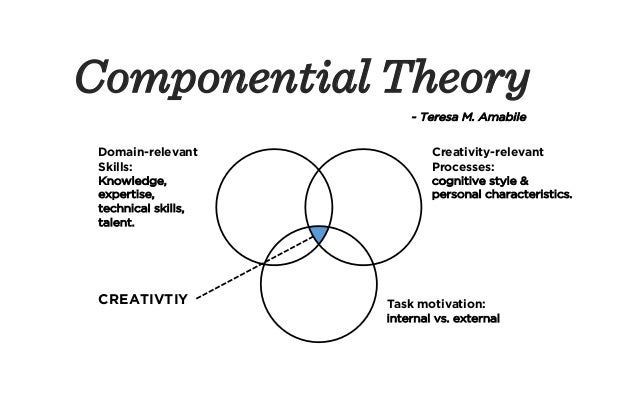
Amabile’s (1988, 2012) componential model of creativity identifies four main components of creativity:

1. domain-relevant skills, which include factual knowledge and technical skills: This highlights the value I bring as the teaching expert, to include subject specific knowledge and model skills relevant to developing my students. I aim to deliver this through media or technique introductions with small and large groups as well as on a need to know basis with individual students. Besides these teacher sessions, I also record the skill/media introductions and load the videos onto our class blog for future reference. For example, this is a clay introduction lesson taught by me to Y2 students in small groups and the video has now been loaded to our class blog for future reference.  http://timeawillemse.blogspot.com/p/3-clay-skills-flipped.html    


Furthermore, these teacher directed lessons are NOT for assessment. They are only the teaching component. Students are given time to develop their own creations using the skills learnt during teacher intro to create their own items considered for assessment.
Below is an example of 6yr old student work. His teacup from the learning session and his Kiwi with fern leaf and grub from his independent session.
These teddy bears were a learning session for 9-10yr olds but by this stage, more confident students are already expanding on the basic teacher instructions as can be seen by the varied details.


Independent work that followed included a range of original ideas, from frogs to foxes.


2. creativity-relevant processes, which Amabile defines as cognitive styles related to taking new perspectives, as well as aspects of personality such as a tolerance for ambiguity and risk-acceptance, plus heuristics* for ideation and divergent thinking: I want my students to become more open-minded so include regular buddy feedback sessions and group conferencing at the start of term. (video augmented with CLIPS to protect student identity)


As student realise the value of (divergent) feedback and one-to-one conferencing, I have noticed that they soon seek this out independently. Another way is when they work on collaborative projects or in collaborative ways. I found play, both structured and unstructured, to be a fantastic avenue to advance heuristic development. Media gets put out in exploratory centres for students to discover. One example of this was when I put out only primary colours and a range of texture making tools - no paintbrushes for a Y2 (6yr old) exploratory session.
The brief was to create with the paint on your card. Their explorations yielded a range of textures and effects plus a range of original colours that they created through mixing. The spontaneous learnings and teachings occurring between students was tremendous. Later they were asked to use this card as both the inspiration as well as the backdrop of their collage design, see examples below.


 By progressing beyond teacher directed projects and developing a Design Thinking Process (DTP) for my classes that supports them to design and create original work, I am also building their tolerance for ambiguity and a true understanding about learning through mistakes that we make along the way. I will elaborate more about the DTP that I am trialling with my students in a later post.


3. intrinsic task motivation: I see this internal, self-motivation coming from the connection that a student feels with the piece that they are working on. This has been true in the past for some students following teacher directed projects, possibly because they are enjoying the making process or prefer being guided as they are low level risk-takers. When students devised and created their own designs for the first time, I noted a sense of apprehension mixed with excitement. As the term proceeded, exceedingly greater engagement was clearly evident. That first trial showed me that time must be built in for students to prototype, especially with media that they are considering using for their display work. They get really nervous about spoiling this and like to have a 'play' first. So I built this session into the programme as a purposeful exploratory time to explore any number of 2D media and then to reflect on the outcomes. I provided different types of paper, for wet and dry media, all cut down to A6 (trading card size). This intervention reduced anxiety about spoiling work as students had the opportunity to learn how the media would perform for them. 
(video augmented with CLIPS to protect student identity)


4. the social environment in which the creative process is taking place, including any extrinsic motivators, organizational norms, or constraints that may operate against the individual. I am lucky enough to have a classroom that students come to. It is known as The Art Space and students make that mental shift as they move between classes. They leave their classrooms where lessons and testing around Literacy, Numeracy and units of Inquiry occur... and arrive in a room filled with artwork on display from other students that is regularly changing as different pieces are progressed. Filled with a wide range of media all visible and promising any number of possibilities. Organisation is quite rigid and students follow this well. On arrival all students must stow away personal devices for safety and until needed, clean hands as all equipment is shared, collect on the mat for a roll call and daily briefing. This may be followed by centre choice, teacher guided lesson, sketchbook explorations or independent action on own work. Most lessons conclude with a reflection which is posted onto students' individual Seesaw accounts, followed by clean up. A music track is played and the room must be re-stored for the next class by the time the track finished (+- 3 min). If not achieved, that class packs up 3min earlier in their next session. Further constraints are imposed in the form of the 'creative box'. Students and given a brief based on the unit of Inquiry they are currently working on. They work through our DTP structure and create original work. Students can break out of this 'creative box' with justification.

For e.g. when a 9yr old made the clay horse above, she broke out of the 'endangered species' box by claiming that if we don't look after our planet and its wildlife, soon its our domestic animals that will be threatened. This was her way of hitting home with her message of concervation.
     
Csikszentmihalyi (2014), although not offering a definition of creativity per se, locates it at the intersection of three systems because no creative achievement can be interpreted or judged in a vacuum.

Image from: www.researchgate.net


  1. the field in which the creative accomplishment must be judged, whose members act as gatekeepers for the domain - for example Visual Art, Drama or Vocal Music subject areas

  2. the cultural domain, which will be responsible for taking up and preserving creative ideas for future generations - the programme, curriculum, principles and attributes valued by the school and its teachers

  3. the person responsible for generating the creative ideas (including motivational, affective, and cognitive factors) - the student 
The investment theory of creativity (Sternberg & Lubart, 1992; Sternberg, 2006) begins with creators taking on unknown or unpopular ideas that show growth potential and pushing these forward until they become accepted. Creativity occurs within the interactions of a number of factors:
Image from: www.mindforlife.org


  1. intellectual abilities or “creative intelligence,” including the ability to synthesize (break the bonds of conventional thinking), and analyse the values of one’s ideas to decide which are worth pursuing, and persuade others (practical-conceptual skills),
  2. knowledge about the domain or discipline, Goldilocks principle applies - some knowledge of the domain is necessary to generate insights, but too much knowledge can make thinking rigid rather than flexible,
  3. thinking styles, or “preferred ways of using one’s skills,” including “a preference for thinking and a decision to think in new ways”, 
  4. personality attributes, such as a tolerance for risks and ambiguity, self-efficacy and perseverance,
  5. intrinsic motivation to engage in the creative tasks,
  6. an environment that supports the creative individual 

In Runco’s view (1996, p. 4), personal creativity ultimately involves some kind of transformation that takes place when a person interprets their experiences. It is inherently subjective and reliant on the perception of the individual. Encompasses problem-solving, problem-finding and articulation. The expression of personal creativity depends on:


Image from: www.researchgate.net


      1. motivation;
      2. certain cognitive styles (interest in novelty, information-seeking, and tolerance for ambiguity);
      3. metaphoric logic, or an aptitude for unconventional ways of thinking; 
      4. discretion or “mindful choice,” about what and how to transform, in an effort to ensure the transformation has utility and value; 
      5. the intention to create, and the use of processes, strategies, and heuristics to support that intention;
      6. relevant domain knowledge and experience.

      To conclude: Elements held in common across these various theories and models include:
      • intrinsic motivation to engage in creative tasks, 
      • domain knowledge and experience, 
      • certain cognitive styles related to unconventional thinking, 
      • a particular set of personality characteristics, 
      • and a supportive social environment (which can include a person’s home and family life, the classroom environment, and the broader social context). 
      image from: https://cdn-images-1.medium.com/


      Each of these elements can be seen as a supporting factor for creative expression or potential.

      Creative construct still requires the elements of novelty or uniqueness, and  relevance, utility, or appropriateness for some purpose.


      *Definition of heuristic: discovery or problem-solving by experimental and especially trial-and-error methods, heuristic techniques, of or relating to exploratory problem-solving techniques that utilize self-educating techniques (such as the evaluation of feedback) to improve performance (https://www.merriam-webster.com/dictionary/heuristic)

      With Love

      Timea


      Thank you for visiting,
      http://www.help-me-learn.com/
      http://www.teacherspayteachers.com/Store/One-Teachers-Journey
      http://www.teachersnotebook.com/shop/tkwillemse
      https://twitter.com/TimeaWillemse
      http://www.youtube.com/user/HelpMeLearnMaths
      http://pinterest.com/tkwillemse/boards/
      Monday, 9 April 2018

      Identify your purpose - Find your motivation (part 3)

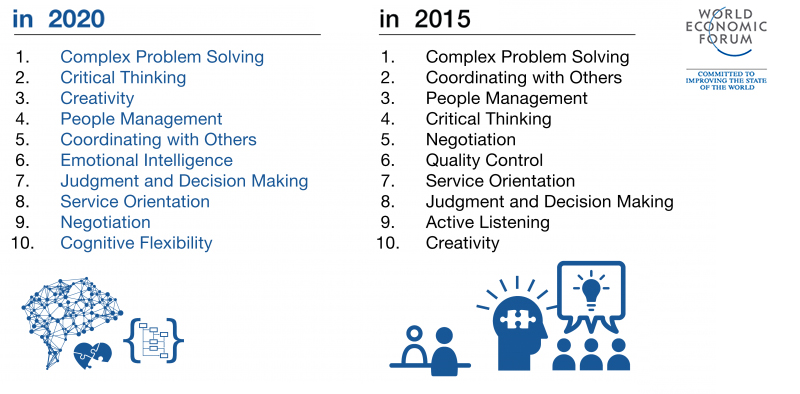
      For me the biggest push to modify my teaching practise in Visual Art was my learning about 21C skills.

      Partnership for 21C learning http://www.p21.org/our-work/p21-framework really got me to examine  the potential added value of my role in the school and helped me to realise the importance of what I could be doing, beyond teaching art.

      For content knowledge and themes, P21 lists Art as the 3rd most important subject - after language arts and world languages, only then is it followed by Maths and the other conventional subjects.

      Mmm! The gravity (and responsibility) of this did not escape me.
      Free image from:images.sipse.com

      To prepare students for an increasingly complex life, 21C learning needs to focus on creativity and critical thinking as a priority, combined with communication and collaboration - the 4Cs.

      What are the 4Cs? https://www.youtube.com/watch?v=QrEEVZa3f98


      On their website, P21 also have downloadable PDFs of ways to assess these 4Cs. Here are the link to the Creativity one:
      http://www.p21.org/component/content/article/36-general/2307-skillsfortodaycreativity
      and
      http://www.p21.org/storage/documents/Skills_For_Today_Series-Pearson/Educators_-_Creativity_Executive_Summary.pdf

      To be effective 21st century citizens and workers, we must be able to create, evaluate, and effectively utilize information, media, and technology.

      P21 identified the following essential Life and Career Skills:
      • Flexibility and Adaptability
      • Initiative and Self Direction
      • Social and Cross-Cultural Skills
      • Productivity and Accountability
      • Leadership and Responsibility
      Well...
      This sure has left me with a lot to think about, and what Cindy Foley spoke about in her TED talk video was gaining more substance for me. (See previous post https://timeawillemse.blogspot.co.nz/2018/04/dive-in-slowly-do-research.html)

      I started reading this White Paper on Creativity from P21 and here is my summery of the Forward and Introduction:

      Lai, E. R., Yarbro, J., DiCerbo, K., & de Geest, E. (2018). Skills for Today: What We Know about Teaching and Assessing Creativity. London: Pearson.

      Creativity - ideas that not only are original and make a unique contribution to the field but also serve some purpose or fulfil some need.
      Nearly every profession can benefit from the infusion of fresh and relevant ideas.
      free image from: realisingtheself.files.wordpress.com


      Creativity is a continuum and can be improved by:
      • teaching approaches that focus on cognitive strategies for problem-solving and divergent thinking, 
      • cooperative or collaborative learning,
      • observational learning, improvisation, role-playing games,
      • some types of diversity training that focus on breaking down stereotypes and challenging assumptions.
      Factors that can contribute to a person’s creative potential include:
      • intrinsic motivation to engage in creative tasks, 
      • domain knowledge and experience, 
      • a facility for unconventional thinking,
      • a particular set of personality characteristics (like openness to taking intellectual risks), 
      • a supportive social environment, whether at home, at school, or on the job.
      Creativity may not always be rewarded in the classroom, because the personality attributes most associated with creativity - independent thinking, nonconformity, and openness to risks - are not necessarily valued by teachers (Westby & Dawson, 1995).
      Likewise, Beghetto (2007) found that prospective teachers tended to prefer student responses that were relevant rather than unique.
      image from: wegrowteachers.com


      Assessing the positive benefits of 'teaching for Creativity' on other areas of learning is challenging because gains are not linear, nor parallel. And benefits may only come into fruition later on.

      Several recent surveys and interviews of executives and human-resources professionals in companies within many sectors and in multiple countries indicate that creativity skills are among the most important skills for employees,
      63 percent of managers and executives agreed or strongly agreed that creativity and innovation would be priorities for employee development, talent management, and succession planning during the next one to three years (American Management Association [AMA], 2012).
      72 percent of global senior executives responded in a survey that innovation was a top priority for their company, (an increase from 64 percent only one year earlier) (Andrew, Manget, Michael, Taylor, & Zablit, 2010).

      Image from: www.supplychain247.com


      Work teams that engage in more creative practices have higher performance than teams that engage in more standardized practices (Gilson, Mathieu, Shalley, & Ruddy, 2005).

      IBM Institute for Business Value (2016) funded a study involving interviews with over 5,000 CEOs from nineteen different industries worldwide, finding that the most financially successful firms in their sample had CEOs who established a culture of innovation that encouraged employee creativity.

      Individual creativity “is the production of a novel and appropriate response, product, or solution to an open-ended task.”

      While innovation requires implementing a creative idea and bringing it to fruition, despite organizational constraints and challenges. Thus, innovation occurs within an organizational environment and requires a host of other skills in order to materialize - such as perseverance, a willingness to take risks, social skills, and good communication (Amabile, 1988). These elements are now informing my assessment practises.

      Factors that help create a classroom environment supportive of creativity include - autonomy, low stakes for making mistakes, and opportunities for collaboration and playfulness.

      Ken Robinson - What is creativity ? (2017)  https://www.youtube.com/watch?v=X1c3M6upOXA

      In this video, Sir Ken makes the point that as teachers, we need to go beyond teaching for creativity and teach with creativity.


      He quotes this poem by writer Anais Nin which also sums up my current position: https://allpoetry.com/poem/8497015-Risk-by-Anais-Nin


      Risk

      And then the day came,
      when the risk
      to remain tight
      in a bud
      was more painful
      than the risk
      it took
      to blossom.

      I guess the time has come to blossom!


      Thank you for visiting,
      With Love

      Timea

      http://www.help-me-learn.com/
      http://www.teacherspayteachers.com/Store/One-Teachers-Journey
      http://www.teachersnotebook.com/shop/tkwillemse
      https://twitter.com/TimeaWillemse
      http://www.youtube.com/user/HelpMeLearnMaths
      http://pinterest.com/tkwillemse/boards/

      ShareThis