Showing posts with label reflective practice. Show all posts

Sunday, 15 April 2018

Risk to Blossom (part 4)

The words in this poem by writer Anais Nin sum up my current position: https://allpoetry.com/poem/


Risk
And then the day came,
when the risk
to remain tight
in a bud
was more painful
than the risk
it took
to blossom.

Over the next few posts I will be reviewing the following White paper on Creativity:
Lai, E. R., Yarbro, J., DiCerbo, K., & de Geest, E. (2018). Skills for Today: What We Know about Teaching and Assessing Creativity. London: Pearson.

Today I looked at the Definitions and Models of Creativity:
image from: https://wegrowteachers.com/

One of the most enduring theories associated with creativity is the model of divergent thinking, which Guilford (1950) popularized. Adapted for the framework of the Torrance Tests of Creative Thinking (TTCT).
Divergent thinking is generally understood as a composite idea-generation skill. The original model of divergent thinking captured in the Torrance tests comprised four subskills:
  1. fluency—the ability to generate many ideas;
  2. flexibility—the ability to move fluidly between different representations;
  3. originality—the ability to produce novel and unusual ideas;
  4. elaboration—the ability to fully develop ideas.
Divergent thinking could be viewed as an indicator of creative potential.
image from:www.slideshare.net/

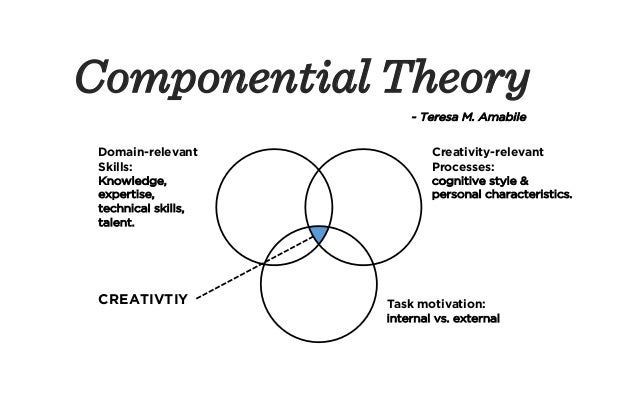
Amabile’s (1988, 2012) componential model of creativity identifies four main components of creativity:

1. domain-relevant skills, which include factual knowledge and technical skills: This highlights the value I bring as the teaching expert, to include subject specific knowledge and model skills relevant to developing my students. I aim to deliver this through media or technique introductions with small and large groups as well as on a need to know basis with individual students. Besides these teacher sessions, I also record the skill/media introductions and load the videos onto our class blog for future reference. For example, this is a clay introduction lesson taught by me to Y2 students in small groups and the video has now been loaded to our class blog for future reference.  http://timeawillemse.blogspot.com/p/3-clay-skills-flipped.html    


Furthermore, these teacher directed lessons are NOT for assessment. They are only the teaching component. Students are given time to develop their own creations using the skills learnt during teacher intro to create their own items considered for assessment.
Below is an example of 6yr old student work. His teacup from the learning session and his Kiwi with fern leaf and grub from his independent session.
These teddy bears were a learning session for 9-10yr olds but by this stage, more confident students are already expanding on the basic teacher instructions as can be seen by the varied details.


Independent work that followed included a range of original ideas, from frogs to foxes.


2. creativity-relevant processes, which Amabile defines as cognitive styles related to taking new perspectives, as well as aspects of personality such as a tolerance for ambiguity and risk-acceptance, plus heuristics* for ideation and divergent thinking: I want my students to become more open-minded so include regular buddy feedback sessions and group conferencing at the start of term. (video augmented with CLIPS to protect student identity)


As student realise the value of (divergent) feedback and one-to-one conferencing, I have noticed that they soon seek this out independently. Another way is when they work on collaborative projects or in collaborative ways. I found play, both structured and unstructured, to be a fantastic avenue to advance heuristic development. Media gets put out in exploratory centres for students to discover. One example of this was when I put out only primary colours and a range of texture making tools - no paintbrushes for a Y2 (6yr old) exploratory session.
The brief was to create with the paint on your card. Their explorations yielded a range of textures and effects plus a range of original colours that they created through mixing. The spontaneous learnings and teachings occurring between students was tremendous. Later they were asked to use this card as both the inspiration as well as the backdrop of their collage design, see examples below.


 By progressing beyond teacher directed projects and developing a Design Thinking Process (DTP) for my classes that supports them to design and create original work, I am also building their tolerance for ambiguity and a true understanding about learning through mistakes that we make along the way. I will elaborate more about the DTP that I am trialling with my students in a later post.


3. intrinsic task motivation: I see this internal, self-motivation coming from the connection that a student feels with the piece that they are working on. This has been true in the past for some students following teacher directed projects, possibly because they are enjoying the making process or prefer being guided as they are low level risk-takers. When students devised and created their own designs for the first time, I noted a sense of apprehension mixed with excitement. As the term proceeded, exceedingly greater engagement was clearly evident. That first trial showed me that time must be built in for students to prototype, especially with media that they are considering using for their display work. They get really nervous about spoiling this and like to have a 'play' first. So I built this session into the programme as a purposeful exploratory time to explore any number of 2D media and then to reflect on the outcomes. I provided different types of paper, for wet and dry media, all cut down to A6 (trading card size). This intervention reduced anxiety about spoiling work as students had the opportunity to learn how the media would perform for them. 
(video augmented with CLIPS to protect student identity)


4. the social environment in which the creative process is taking place, including any extrinsic motivators, organizational norms, or constraints that may operate against the individual. I am lucky enough to have a classroom that students come to. It is known as The Art Space and students make that mental shift as they move between classes. They leave their classrooms where lessons and testing around Literacy, Numeracy and units of Inquiry occur... and arrive in a room filled with artwork on display from other students that is regularly changing as different pieces are progressed. Filled with a wide range of media all visible and promising any number of possibilities. Organisation is quite rigid and students follow this well. On arrival all students must stow away personal devices for safety and until needed, clean hands as all equipment is shared, collect on the mat for a roll call and daily briefing. This may be followed by centre choice, teacher guided lesson, sketchbook explorations or independent action on own work. Most lessons conclude with a reflection which is posted onto students' individual Seesaw accounts, followed by clean up. A music track is played and the room must be re-stored for the next class by the time the track finished (+- 3 min). If not achieved, that class packs up 3min earlier in their next session. Further constraints are imposed in the form of the 'creative box'. Students and given a brief based on the unit of Inquiry they are currently working on. They work through our DTP structure and create original work. Students can break out of this 'creative box' with justification.

For e.g. when a 9yr old made the clay horse above, she broke out of the 'endangered species' box by claiming that if we don't look after our planet and its wildlife, soon its our domestic animals that will be threatened. This was her way of hitting home with her message of concervation.
     
Csikszentmihalyi (2014), although not offering a definition of creativity per se, locates it at the intersection of three systems because no creative achievement can be interpreted or judged in a vacuum.

Image from: www.researchgate.net


  1. the field in which the creative accomplishment must be judged, whose members act as gatekeepers for the domain - for example Visual Art, Drama or Vocal Music subject areas

  2. the cultural domain, which will be responsible for taking up and preserving creative ideas for future generations - the programme, curriculum, principles and attributes valued by the school and its teachers

  3. the person responsible for generating the creative ideas (including motivational, affective, and cognitive factors) - the student 
The investment theory of creativity (Sternberg & Lubart, 1992; Sternberg, 2006) begins with creators taking on unknown or unpopular ideas that show growth potential and pushing these forward until they become accepted. Creativity occurs within the interactions of a number of factors:
Image from: www.mindforlife.org


  1. intellectual abilities or “creative intelligence,” including the ability to synthesize (break the bonds of conventional thinking), and analyse the values of one’s ideas to decide which are worth pursuing, and persuade others (practical-conceptual skills),
  2. knowledge about the domain or discipline, Goldilocks principle applies - some knowledge of the domain is necessary to generate insights, but too much knowledge can make thinking rigid rather than flexible,
  3. thinking styles, or “preferred ways of using one’s skills,” including “a preference for thinking and a decision to think in new ways”, 
  4. personality attributes, such as a tolerance for risks and ambiguity, self-efficacy and perseverance,
  5. intrinsic motivation to engage in the creative tasks,
  6. an environment that supports the creative individual 

In Runco’s view (1996, p. 4), personal creativity ultimately involves some kind of transformation that takes place when a person interprets their experiences. It is inherently subjective and reliant on the perception of the individual. Encompasses problem-solving, problem-finding and articulation. The expression of personal creativity depends on:


Image from: www.researchgate.net


      1. motivation;
      2. certain cognitive styles (interest in novelty, information-seeking, and tolerance for ambiguity);
      3. metaphoric logic, or an aptitude for unconventional ways of thinking; 
      4. discretion or “mindful choice,” about what and how to transform, in an effort to ensure the transformation has utility and value; 
      5. the intention to create, and the use of processes, strategies, and heuristics to support that intention;
      6. relevant domain knowledge and experience.

      To conclude: Elements held in common across these various theories and models include:
      • intrinsic motivation to engage in creative tasks, 
      • domain knowledge and experience, 
      • certain cognitive styles related to unconventional thinking, 
      • a particular set of personality characteristics, 
      • and a supportive social environment (which can include a person’s home and family life, the classroom environment, and the broader social context). 
      image from: https://cdn-images-1.medium.com/


      Each of these elements can be seen as a supporting factor for creative expression or potential.

      Creative construct still requires the elements of novelty or uniqueness, and  relevance, utility, or appropriateness for some purpose.


      *Definition of heuristic: discovery or problem-solving by experimental and especially trial-and-error methods, heuristic techniques, of or relating to exploratory problem-solving techniques that utilize self-educating techniques (such as the evaluation of feedback) to improve performance (https://www.merriam-webster.com/dictionary/heuristic)

      With Love

      Timea


      Thank you for visiting,
      http://www.help-me-learn.com/
      http://www.teacherspayteachers.com/Store/One-Teachers-Journey
      http://www.teachersnotebook.com/shop/tkwillemse
      https://twitter.com/TimeaWillemse
      http://www.youtube.com/user/HelpMeLearnMaths
      http://pinterest.com/tkwillemse/boards/

      Monday, 9 April 2018

      Identify your purpose - Find your motivation (part 3)

      For me the biggest push to modify my teaching practise in Visual Art was my learning about 21C skills.

      Partnership for 21C learning http://www.p21.org/our-work/p21-framework really got me to examine  the potential added value of my role in the school and helped me to realise the importance of what I could be doing, beyond teaching art.

      For content knowledge and themes, P21 lists Art as the 3rd most important subject - after language arts and world languages, only then is it followed by Maths and the other conventional subjects.

      Mmm! The gravity (and responsibility) of this did not escape me.
      Free image from:images.sipse.com

      To prepare students for an increasingly complex life, 21C learning needs to focus on creativity and critical thinking as a priority, combined with communication and collaboration - the 4Cs.

      What are the 4Cs? https://www.youtube.com/watch?v=QrEEVZa3f98


      On their website, P21 also have downloadable PDFs of ways to assess these 4Cs. Here are the link to the Creativity one:
      http://www.p21.org/component/content/article/36-general/2307-skillsfortodaycreativity
      and
      http://www.p21.org/storage/documents/Skills_For_Today_Series-Pearson/Educators_-_Creativity_Executive_Summary.pdf

      To be effective 21st century citizens and workers, we must be able to create, evaluate, and effectively utilize information, media, and technology.

      P21 identified the following essential Life and Career Skills:
      • Flexibility and Adaptability
      • Initiative and Self Direction
      • Social and Cross-Cultural Skills
      • Productivity and Accountability
      • Leadership and Responsibility
      Well...
      This sure has left me with a lot to think about, and what Cindy Foley spoke about in her TED talk video was gaining more substance for me. (See previous post https://timeawillemse.blogspot.co.nz/2018/04/dive-in-slowly-do-research.html)

      I started reading this White Paper on Creativity from P21 and here is my summery of the Forward and Introduction:

      Lai, E. R., Yarbro, J., DiCerbo, K., & de Geest, E. (2018). Skills for Today: What We Know about Teaching and Assessing Creativity. London: Pearson.

      Creativity - ideas that not only are original and make a unique contribution to the field but also serve some purpose or fulfil some need.
      Nearly every profession can benefit from the infusion of fresh and relevant ideas.
      free image from: realisingtheself.files.wordpress.com


      Creativity is a continuum and can be improved by:
      • teaching approaches that focus on cognitive strategies for problem-solving and divergent thinking, 
      • cooperative or collaborative learning,
      • observational learning, improvisation, role-playing games,
      • some types of diversity training that focus on breaking down stereotypes and challenging assumptions.
      Factors that can contribute to a person’s creative potential include:
      • intrinsic motivation to engage in creative tasks, 
      • domain knowledge and experience, 
      • a facility for unconventional thinking,
      • a particular set of personality characteristics (like openness to taking intellectual risks), 
      • a supportive social environment, whether at home, at school, or on the job.
      Creativity may not always be rewarded in the classroom, because the personality attributes most associated with creativity - independent thinking, nonconformity, and openness to risks - are not necessarily valued by teachers (Westby & Dawson, 1995).
      Likewise, Beghetto (2007) found that prospective teachers tended to prefer student responses that were relevant rather than unique.
      image from: wegrowteachers.com


      Assessing the positive benefits of 'teaching for Creativity' on other areas of learning is challenging because gains are not linear, nor parallel. And benefits may only come into fruition later on.

      Several recent surveys and interviews of executives and human-resources professionals in companies within many sectors and in multiple countries indicate that creativity skills are among the most important skills for employees,
      63 percent of managers and executives agreed or strongly agreed that creativity and innovation would be priorities for employee development, talent management, and succession planning during the next one to three years (American Management Association [AMA], 2012).
      72 percent of global senior executives responded in a survey that innovation was a top priority for their company, (an increase from 64 percent only one year earlier) (Andrew, Manget, Michael, Taylor, & Zablit, 2010).

      Image from: www.supplychain247.com


      Work teams that engage in more creative practices have higher performance than teams that engage in more standardized practices (Gilson, Mathieu, Shalley, & Ruddy, 2005).

      IBM Institute for Business Value (2016) funded a study involving interviews with over 5,000 CEOs from nineteen different industries worldwide, finding that the most financially successful firms in their sample had CEOs who established a culture of innovation that encouraged employee creativity.

      Individual creativity “is the production of a novel and appropriate response, product, or solution to an open-ended task.”

      While innovation requires implementing a creative idea and bringing it to fruition, despite organizational constraints and challenges. Thus, innovation occurs within an organizational environment and requires a host of other skills in order to materialize - such as perseverance, a willingness to take risks, social skills, and good communication (Amabile, 1988). These elements are now informing my assessment practises.

      Factors that help create a classroom environment supportive of creativity include - autonomy, low stakes for making mistakes, and opportunities for collaboration and playfulness.

      Ken Robinson - What is creativity ? (2017)  https://www.youtube.com/watch?v=X1c3M6upOXA

      In this video, Sir Ken makes the point that as teachers, we need to go beyond teaching for creativity and teach with creativity.


      He quotes this poem by writer Anais Nin which also sums up my current position: https://allpoetry.com/poem/8497015-Risk-by-Anais-Nin


      Risk

      And then the day came,
      when the risk
      to remain tight
      in a bud
      was more painful
      than the risk
      it took
      to blossom.

      I guess the time has come to blossom!


      Thank you for visiting,
      With Love

      Timea

      http://www.help-me-learn.com/
      http://www.teacherspayteachers.com/Store/One-Teachers-Journey
      http://www.teachersnotebook.com/shop/tkwillemse
      https://twitter.com/TimeaWillemse
      http://www.youtube.com/user/HelpMeLearnMaths
      http://pinterest.com/tkwillemse/boards/

      Thursday, 5 April 2018

      Dive in slowly - Do research (part 2)

      I had my reservations about a complete and immediate switch from my teacher-directed and skill based art programme, to a student-directed one http://teachingforartisticbehavior.org/

      So I moved slower - for 2 reasons.
      One was to have the time to reflect on the effect that degrees of choice had on a range of students, giving me time to observe, be observed, interview students, adjust, create support as needed and research.
      The other was to build confidence gradually in the students who had already been learning in the conventional teacher-directed method.

      With students who moved from experimentation at Kindy the year prior, I used a 50/50 combination of teacher-directed mini lessons and students directed choice sessions that I alternated with. This year group probably had the most influence on me.

      Due to their, as yet, uninhibited approach to creating in visceral, haptic (active exploration) and tactile ways, their level of engagement, independence, free collaboration and detailed explanations were second to none.

      In comparison, when I engaged the same group in teacher-directed mini projects, their neediness multiplied tenfold and the words "can you help me", "I can't do this", "mine's not good", "I made a mistake", etc. were continually repeated. Self-criticism rose and confidence seemed to diminish rapidly when students were expected to conform to the same outcome, at the same pace. In hindsight, I believe these clues were always there but I just didn't know to look for them.
      Yes the skill level shown in the teacher directed pieces seemed more developed, but when they returned to independent work, this 'learnt skill' seemed to evaporate.

      Last year, I compiled some points that emerged from observations, in this table. Green boxes are the positives I noted at the time.

      I also rewatched one of my favourite TED talks - https://www.ted.com/talks/ken_robinson_says_schools_kill_creativity/transcript?language=en


      Sir Ken Robinson - Do Schools Kill Creativity?

      And came across this amazing video https://www.youtube.com/watch?v=ZcFRfJb2ONk&t=24s


      Cindy Foley - Teaching art or teaching to think like an artist?

      I was feeling nervous about the innovations I was contemplating as it opposed the reality of current practise in our classrooms. I had been fortunate to attend an inspiring key note talk by Professor Welby Ings from AUT at a previous art teacher conference, and was glad to find that in his book - Disobedient Teaching, he argues that positive disobedience is a fundamental teaching behaviour among successful practitioners, and excellent teachers show the ability to change learning programmes and learning environments to suit their students.

      Here is his TED talk from 2013  https://www.youtube.com/watch?v=aumxbgOdkRU


      Welby Ings - Disobedient Thinking:  at TEDxAuckland

      Books that opened my perspective still further included:

      Ings, W. (2017). Disobedient teaching: Surviving and creating change in education. (Kindle Edition). Otago, New Zealand: Otago University Press.


      and

      Jaquith, D. B., & Hathaway, N.E. (2012). Learner-directed classroom : Developing creative thinking skills through art. New York, United States of America: Teachers College Press.


      and articles by:

      Gaw, C. (September 05, 2016). What is an ethical pedagogy? Retrieved 12 August 2017 from http://clydegaw.blogspot.co.nz/search?updated-max=2017-02-28T16:44:00-08:00

      Jaquith, D. B. (2011). When is Creativity? Art Education, 64(1), 14-19.

      Purtee, M. (2016). Teaching skills for the 21st century: Creativity. The Art of Education. Retrieved 7 August 2017 from https://www.theartofed.com/2016/04/20/teaching-skills-21st-century-creativity

      Social and online media also played a big part:

      The TAB website http://teachingforartisticbehavior.org/ was a minefield of ideas,

      Block paper Scissors podcasts by Clyde Gaw and Clark Fralick
      and their personal blogs which can be found at:
      http://clydegaw.blogspot.co.nz/  and    http://sceart1.blogspot.co.nz/

      And the Facebook pages for Teaching for Artistic behaviour are great places to ask questions.

      All this research and reflection takes a lot of time but is well worth it. You need to feel confident in your deeper levels of knowledge and not run merely on superficial impressions. The chances are you will be challenged - by supervisors, colleagues, students, parents and members of the on-line teaching community.


      http://clipartmag.com/research-clipart#research-clipart-20.gif
      If you are also wrestling with these issues or have some great resources to recommend, I would love to hear from you so please comment below.

      Thank you for visiting,
      With Love, Te Aroha

      Timea


      Sunday, 1 April 2018

      A better way - Reflecting on the start of my journey to TAB principles (part 1)

      Post Mindlab - a retrospective

      It is so interesting how much your perspective changes about education, the minute you step outside of your single cell classroom.

      As a classroom teacher for many years, I believed that I knew best what my class of students needed to progress their learning, and to some extend that was true. But it is only when I moved into a specialist role, teaching across 7 age groups that I got a much wider indication of some of the traps I fell into in the past.

      It is so easy to think only of that one year that you are teaching and to meet your targets at all cost. But once you see students develop from ages 4 to 11, you quickly become aware of the long game.

      When I took on my current role as Visual Art and Digital Media specialist, I had a big learning curve ahead but was ready for the challenge. I have a passion for learning, the creative arts and technology, the rest was going to develop through research and observation.
      I started with a teacher directed approach that focused on practical skill development and scaled formulaic projects up across year levels. Nothing new to see here as this is the best way to teach skills in art, or so I thought.
      After pulling together the first art show (in my first year in this role), I knew there was something not quite right about this way of learning art. The final clincher was when I shows student work at a school cluster art show in the local shopping mall. Several works from a range of schools were instantly recognisable as Pinterest staples. Very embarrassing. 

      I wanted more variety of work from within the year levels and started trying to modify the same recipe for each class but wanting them all to still be getting the same skill development. Basically, I was still focusing on the skills that I felt they should be developing, rather than what individual students really needed.

      Some early attempts at teacher-directed differentiation across 4 Year 2 classes - Seasons using Collage technique:
      Spring Winds

      Summer Flowers

      Winter Snowglobes

      Autumn Leaves


      Some early attempts at teacher-directed differentiation across 3 x Year 3 classes - Savannah Habitats using the Crayon and Liquid water colours (Dye) with drawing technique:
      Zebra

      Elephant

      Giraffe

      Some early attempts at teacher-directed differentiation across 3 x Year 4 classes - Monet using the Tache technique:


      Then, I first came across Teaching for Artistic Behaviour (TAB) in one of my many online explorations.

      In 2016, I discussed the notion of offering some choice options to my Year 5 and 6 students (last 2 years of primary) to see how they would cope, with my assistant principal . We were staging 'The Lion King' for our school production, so I thought - what a great opportunity to engage the students with all things Africa.
      The rest of the year groups I continued to teach through directed lessons with a skill focus, apart from Kindy, who came in to explore with different media each week.

      I offered Paint (acrylic, water colour), Drawing (pencil, coloured pencil, oil pastel) and Sculpture (papier mache) centres to my Year 5s to select from.
      The Year 6s also had  collage, photography and clay on offer.
      The only guidance I gave initially was to  show how the same concept can be created in a range of sources and I collated some Youtube videos on techniques for most of these resources. I linked these into our 'in-house' student digital resource page.

      Choice centres across 3 x Year 6 classes - Africa:
      Liquid water colours (Dye) and Collage

      Acrylic on Canvas Board

      Clay Elephant

      Photography

      Photography

      Photography

      Clay African pots

      Clay Rhino

      Papier Mache Rhino

      Papier Mache African Mask


      I also would spend 5-10 minutes in a centre to introduce or review specific skills or techniques during lessons but would roam the rest of the time to support individual students on request. While they were learning independence and building confidence in themselves, they were teaching me to let them be, to let them self discover and construct personal knowledge, and to share these learnings through collaboration with their peers. 

      Yes I had my worries but was so excited to see what the students would do when given the choice to pursue personal passions. 


      Te Aroha, with love

      Timea


      Thank you for visiting,
      http://www.help-me-learn.com/
      http://www.teacherspayteachers.com/Store/One-Teachers-Journey
      http://www.teachersnotebook.com/shop/tkwillemse
      https://twitter.com/TimeaWillemse
      http://www.youtube.com/user/HelpMeLearnMaths
      http://pinterest.com/tkwillemse/boards/
      Tuesday, 27 March 2018

      Time To Breathe - as Mindlab ends

      Dear readers,
      Today I submitted my final assignments for my Mindlab course after 1 year part time study (and full time work/life). This will earn me a postgraduate certificate in Applied Practice (Digital & Collaborative Learning).
      http://themindlab.com/postgrad-studies/programme-overview/

      A bit of a mouth full.
      I explained a little more about it in this post here http://timeawillemse.blogspot.co.nz/2017/11/post-graduate-study-with-mind-lab-1.html

      The last 8 posts have all been part of assignment 4. Applied Practice in Context – 15 credits. It was a requirement of the course to post these on a blog and share with a community of your choosing. This could be to only your course moderators, or the student G+ community or if you are an existing blogger like me, with the wider teaching community. Hence the more formal structure.
      Thank you for bearing with me through it all.

      This course has given me the tools to transition my programme to TAB principles (Teaching artists - not Art) which has been so rewarding.
      I have had a lot of Aha! moments as I made changes in my teaching programme over the year and look forward to sharing these with you all.

      But first, a little time to rest and incubate  (Design Thinking Process), over the Easter break.
      Vincent van Gogh [Public domain], via Wikimedia Commons


      Ki Te Aroha (with love)

      Timea


      Thank you for visiting,
      http://www.help-me-learn.com/
      http://www.teacherspayteachers.com/Store/One-Teachers-Journey
      http://www.teachersnotebook.com/shop/tkwillemse
      https://twitter.com/TimeaWillemse
      http://www.youtube.com/user/HelpMeLearnMaths
      http://pinterest.com/tkwillemse/boards/
      Friday, 23 March 2018

      This is me! - Key change in my professional practice. Mindlab Activity 8

      What: The key changes in my professional practise link to the Teaching Standard (Standards for the Teaching Profession, p20, 2017.)
      Figure 1. Teaching standards (Standards for the Teaching Profession, p20, 2017.)

      The Mindlab course was the perfect vehicle to launch my explorations into methods of teaching Visual Art that aligned with current pedagogical understandings. Investigations into the use of digital technologies to support differentiation for learners, and guiding development in leadership skills, helping me to implement innovations around student agency. Affiliating with like-minded learners inquiring into future trends in education gave me confidence to scale innovations school-wide and run staff PLs.

      Now what?
      Using the Reflective Practice Experiential Learning Cycle (Osterman and Kottkamp (2015, p.70)

      Stage 1: Problem Identification.
      School art shows revealed teacher-directed learning to be the norm throughout our junior school. As I was developing student agency in my specialist subject area, a dissonance with the way art is being taught in classrooms, appeared. When students are being affected by contradicting expectations, it is time to drive school-wide change. The potential for a flow-on effect whereby students transfer agency learnt in this subject area, across to other areas of learning is valuable. Furthermore, teachers experiencing this way of teaching in their own classrooms, can potentially incorporate these characteristics across other areas of their teaching.

      Stage 2: Observation and Analysis.
      Observations of my lessons and interviews with my students have revealed that those experiencing agency were more engaged and easily follow their own inquiries, collaborate with others, show confidence to take new risks and felt ownership of their creations, which were personal, original and age appropriate.

      Walk-throughs of classrooms showed a contrast in the teaching approach. Uniform sets of artwork hung on walls and in some cases, teachers had modified student work to ‘improve’ it for display.
      Figure 2. When You Do It For Me (Wall Poster, nd).

      Stage 3. Abstract Re-conceptualization
      Figure 3. Clark Fralick and Clyde Gaw (Block Paper Scissors Podcasts, nd)
      Figure 4. Bergmann and Sams (Flipped Learning Worldwide Podcast, nd)
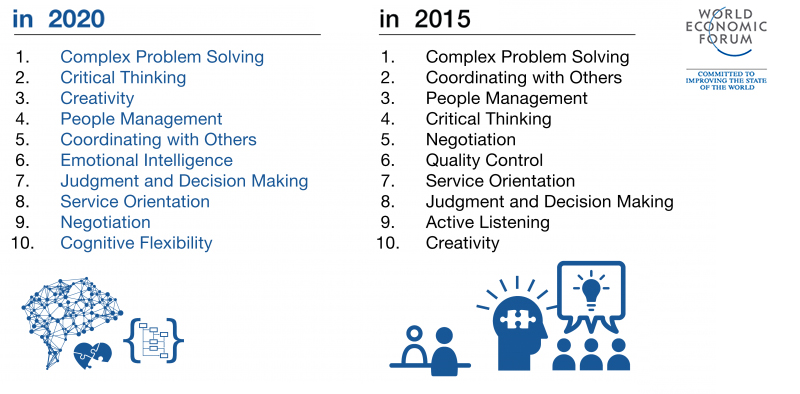
      Mindlab has encouraged me to further expand my participation in CoPs and CoLs online, where I continue to explore resources and practitioner exemplars on teaching for student agency. By collating and using a range of teaching techniques to develop the 21C skills of Complex Problem Solving, Creativity and Critical Thinking (World Economic Forum, 2016), I am further expanding on my learnings from this course. The Design Thinking Challenge lecture (week 14) initiated further explorations for me and I developed a process for our school to follow, which I introduced at staff Professional Learning (PL).


      Photo 1: My junior Design Thinking Process (DTP) posters introduced to Y1-4. (Willemse 2018).

      Photo 2: My senior DTP posters introduced to Y5-6. (Willemse 2018).


      Stage 4: Active Experimentation

      Two questions that initially came back from teachers were around time and prototyping. Invitation based follow-up sessions with planning teams have helped me to analyse both the understandings and misconceptions they had arrived at from the whole-staff PL. I used ‘Teaching for agency’ principles with planning teams to devise their own solutions during our meetings, to help them take ownership of the teaching aspect.

      Working through the DTP, teachers realised how they had owned the first 5 steps in the process and were only inviting students in at the ‘Make’ stage, and they particularly liked the ‘Rest’ or ‘Incubate’ stage. DTP was noted to support other learning, areas like writing and inquiry. Now teachers have started using it here too.

      Walk-throughs have now revealed changes in classroom practices in the Arts. Below is a display sample of before and after from the same Y1 classroom, 2 months apart.
      Photo 3: Before - early February (Willemse 2018).
      Photo 4: After - late March (Willemse 2018).
      Another connection to this teaching approach has been Mauri Ora or Relationship teaching and learning (week 31). Valued contributions from our culturally diverse group of students and teachers has been a rewarding development, as we all learn more deeply about each other than when we use teacher-directed models.

      3. What next?
       
      Future developments to explore include relevant assessment practises that reflect this change in teaching focus. Looking into Hack Education’s ideas about the future of education in New Zealand, these changes begin to address the individual learner in a contemporary world.

      The role of technology and how it can support choice and differentiation in a specialist subject, is my next focus as I create content for students and teachers in video format. Where possible, recordings will be of students at work to model concepts - students learning from other students.

      Photo 5: Our Art Blog search menu - site access restricted to school students due to privacy policy. (Willemse 2018)

      Photo 6: Our first few posts - site access restricted to school students due to privacy policy. (Willemse 2018).


      REFERENCES:

      Bergmann J., & Sams, A., (nd). Flipped Learning Worldwide Podcasts. Retrieved from https://itunes.apple.com/us/podcast/flipped-learning-worldwide/id646787432?mt=2

      Brown, T. (2009). Change by Design – How Design Thinking Transforms Organization and Inspires Innovation. Harper Collins, USA

      Design Thinking for Educators (nd). Retrieved from https://designthinkingforeducators.com/

      Education Council. (2017). Our Code Our Standards.Retrieved from: https://educationcouncil.org.nz/sites/default/files/Our%20Code%20Our%20Standards%20web%20booklet%20FINAL.pdf

      When you do it for me (nd) Wall Poster. Retrieved from https://i.pinimg.com/originals/c7/aa/a1/c7aaa12be7c194e4b5cd17774a06e9d6.jpg

      Fralick C., & Gaw C. (nd). Block, Paper, Scissors Podcasts. Retrieved from https://itunes.apple.com/us/podcast/blocks-paper-scissors/id1302971793?mt=2

      Ministry of Education (nd). Our code, our standards. Retrieved from https://educationcouncil.org.nz/content/our-code-our-standards

      Osterman, K. F., & Kottkamp, R. B. (2015). Reflective practice for educators : professional development to improve student learning.(2nd ed.) New York: Skyhorse Publishing.

      Rolfe et al.'s reflective model, (2001). Adapted from: Rolfe, G., Freshwater, D., Jasper, M. (2001) Critical reflection in nursing and the helping professions: a user's guide. Retrieved from https://my.cumbria.ac.uk/media/MyCumbria/Documents/ReflectiveModelRolfe.pdf

      Willemse, T. (2018) Photo1-6


      With Love,

      Timea


      Thank you for visiting,
      http://www.help-me-learn.com/
      http://www.teacherspayteachers.com/Store/One-Teachers-Journey
      http://www.teachersnotebook.com/shop/tkwillemse
      https://twitter.com/TimeaWillemse
      http://www.youtube.com/user/HelpMeLearnMaths
      http://pinterest.com/tkwillemse/boards/

      ShareThis