Showing posts with label Post-graduate study. Show all posts

Friday, 28 December 2018

Exploring strategies for teaching creative thinking Part 4

In my previous post I wrote about how I applied the research of  Anderson and Yates (1999), who taught artistic clay work to six-year-old students using social modelling and cognitive learning principles, to my clay lessons with Y3 and 4 students (age 7-9).

In this post I write about how I scaled it up to Year 5-6 students (aged 10-11), and what I observed.

With older students (Y5/6), I no longer modelled physically. Instead I loaded a you tube video for them to watch and follow independently before they cycled through the clay centre. This was in an effort to further develop both independence and collaboration among the small groups, as well as their decision making/problem solving skills. This video can be found here. 

While this was sufficient for approximately half the students, others still needed my hands on support to work through the process of constructing a figurine. Reasons ranged from lack of experince with the medium, to limited short to term memory retention, to students on learning support for processing disorders.
Independent students personalised their directed work, with much less encouragement, some applying the concepts in the video tutorial to a completely different subject (the video is a guided lesson that produces a bear).
This showed that some students were ready to move beyond the exemplar once it had done the job of visually reinforcing clay work skills learnt previously. These students did not need the practical step-by-step learning, while others still benefited from that.
 

Y5-6 students have choice of media for their Wall / Wow Work (for displays/artshows etc), so not all chose to create with clay following the tutorial centre, but those that did, produced impressive work.

Year 5 - based on inquiry unit Sharing the Planet (IB PYP), animals under threat


Year 6 - Independent and self directed work


What does the research say:
Groenendijk, Janssen, Rijlaarsdam, and van den Bergh (2013) examined ninth-grade students who were taught the same design strategy steps (based on Sapp (1995), involving various divergent (producing ideas and sketches) and convergent (evaluating ideas and making choices) stages. One group also had  observational learning added, where students watched videos of other students completing design tasks which showed work in progress along with 'thinking aloud' through the design steps. Results show that observational learning had a positive impact on creativity, but only for high-aptitude students. For low-aptitude students, creativity improved
equally in both the observational-learning and direct-strategy instruction conditions. (see my noted observations above with the introduction video to clay)

In their study, Yi, Plucker, and Guo (2015) considered how modelling influenced divergent thinking in a sample of Grade 8 students. All groups were asked to complete verbal and figural divergent-thinking tasks, but one group were shown creative models prior to completing theirs. These students produced work product with higher scores on creativity, technical quality, imagination, artistic level, elaboration, and overall impression. Regarding divergent thinking, viewing models positively impacted all three facets of divergent thinking on the verbal tasks (fluency, flexibility, and originality) but not on the figural tasks.

With all this in mind, I started work on a digital resource where I could load videos that can support students in learning centres. These can be videos I make as time permits or ones I link from Youtube. This works mainly for students from Y4 up as they all have personal iPads at school and can easily access on-line resources. For younger students, I would continue to model in small groups, print out exemplar images, show video on the classroom TV monitor and rotate through familiar centres. I include exemplars of work from my own students where possible. As many of the videos have my students in them, I cannot share the link to the site, but I have started linking the public ones to this blog under the Flipped-Learning link at the top.

Once I have used these a bit more, I'll share my observations with you here in a future post :)

Thank you for stopping by,
With love, Te Aroha
Timea
http://www.help-me-learn.com/
http://www.teacherspayteachers.com/Store/One-Teachers-Journey
http://www.teachersnotebook.com/shop/tkwillemse https://twitter.com/TimeaWillemse http://www.youtube.com/user/HelpMeLearnMaths
http://pinterest.com/tkwillemse/boards/
https://www.instagram.com/timea_oneteachersjourney/

Exploring strategies for teaching creative thinking Part 3

In my previous post I wrote about how I applied the research of  Anderson and Yates (1999), who taught artistic clay work to six-year-old students using social modelling and cognitive learning principles, to my own clay lessons with Y1 and 2 students (age 5-6).

In this post I write about how I scaled it up to Year 3-4 students (aged 7-9), and what I observed.

Year 3 were given teacher workshops to develop their understanding of slab work, with applied relief and imprinted textures.

We worked on boat-scapes to compliment their unit on explorers and offered some directed choice options for students to personalise their tiles (e.g. orientate your slab portrait or landscape, this is how you can turn this circle into a sun or a moon then place it anywhere in the sky, or add a second boat/wave if you wish, of your own design, or choose from these 4 texture rollers to imprint your water, etc).


These workshops were followed by an independent session where students were required to create a bird sculpture, continuing the theme of exploration and the applied concept of freedom. The initial intention was to base their birds on the slab technique learnt in the workshop. I supplied students with a number of reference photographs of slab bird sculptures to use for inspiration. However, I also included a few 3D bird sculptures just to see who might be ready / enticed to give that a go.
Bone dry and ready for the kiln


I was impressed by how many did. But still just as many weren't ready to go that next step so it was good to have a range for students to refer to. A range of paint options were also available for finishing after the bisque fire. Students could choose from liquid water colour (dye), tempera, metallic acrylics or left uncoloured and dipped in clear glaze for re-firing.


With Year 4 students (aged 8-9), the teacher directed lessons modelled a cat figurine (tying in with the school production of Aristocats).

As with the Y3 students, Y4 were also given directed choice options to personalise their figurine. These included selecting preferred cutters for the base, the shape of the body and tail position.
I noticed during these teacher directed 'workshops', students were keen to personalize their work at every opportunity and my message was to embrace the uniqueness of their shapes and creations. The steps were a learning guide rather that a requirement and students were left to independently add further personal details for the last 5-10 minutes of their workshops. One student completely personalised his cat into a dog :)

This year group painted their cats with underglaze once bone dry, then they were bisque fired before I glazed and refired them.

I did not model how to apply the glaze so originality and creativity was even more evident in this step as students ranged from realistic designs based on pets they knew, to artistic pattern and colour interpretations. There were no rules but some reference images were provided on the board to indicate a range. None of these were copied, but some students did use the reference images as a starting point.


These workshops were then followed by an independent session where students used the skills they had learnt in the workshops to create a self portrait figurine, to show personal traits, interests or talents.


Students were given very limited time (only a single period) to create these figurines. Despite this constraint, they produced some remarkable and original work. There was a lot of conversation among the students as they supported each other through the making challenge.
This consolidation time was incredibly valuable for learning as students figured out what they remembered (or had forgotten) from their workshops and how they could apply those learnings to new elements that they wanted to create. For e.g. rolling a coil for a cat's tail worked for rolling thinner coils to make locks of hair. Again, the figurines were left to air-dry before under-glazing so there were mishaps with bits falling off. This learning will stay with them for future lessons about the importance of solid joins.
I created a teaching video for making a figurine, following these sessions, and included the elements that were challenging for the students. This video will be available to them next year to review before they start on their next clay artwork, which will be an independently conceived and created piece.  

My next post will detail the lessons and outcomes observed with Y5-6 students .


Thank you for stopping by,
With love, Te Aroha
Timea
http://www.help-me-learn.com/
http://www.teacherspayteachers.com/Store/One-Teachers-Journey
http://www.teachersnotebook.com/shop/tkwillemse https://twitter.com/TimeaWillemse http://www.youtube.com/user/HelpMeLearnMaths
http://pinterest.com/tkwillemse/boards/
https://www.instagram.com/timea_oneteachersjourney/

Tuesday, 18 December 2018

Exploring strategies for teaching creative thinking Part 2

Observational Learning and Modelling:
Of particular interest to me in my teaching area, was whether observational learning or exposure to creative models can enhance creativity, or limit it. For the past year, I have been struggling with this concept because my observations have shown that when a teacher models a completed product for students, they view that as the 'right answer' and may stop pushing the boundaries of their own original thinking. The quality and technical skills of students are however, much improved when they follow a teacher model / recipe lesson. So I was interested to read what the research says about this?

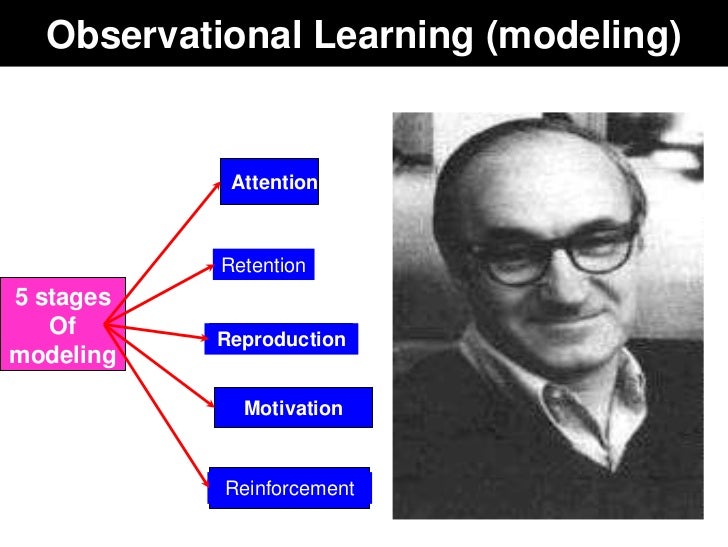
Bandura’s (1986) social learning theory suggests that individuals acquire new skills by watching the work of others. These modelling studies examine creativity through art and design learning.

Anderson and Yates (1999) taught artistic clay work to six-year-old students using social modelling and cognitive learning principles across a six-week period (ninety minutes of instruction per week - for me that would be 2 x 45 min periods). During the class, the teacher modelled techniques for working with clay, verbalizing her actions to give students a vocabulary for discussing clay-modelling processes. The class also involved frequent skill practice. The creative-work products (i.e. clay-work designs) of students receiving the modelling intervention were compared to those of students taught using traditional, non-directive curriculum practices. Results indicate that the modelling intervention had a positive impact on
  • technical competence, 
  • decorative competence, 
  • aesthetic appeal, and 
  • three-dimension approximation. 

Albert Bandura - Social Learning Theory

I only have my students for 8-10 weeks a year so while I tried out this approach for the clay centre with students aged 4-6, I didn't have the extended time that is discussed in the research. But I do get students back each year so I view it as a longitudinal study where we can build on skills each year.
I rotated small groups through a clay workshop each period while the others created independently in drawing and modelling clay centres. We all made the identical object (a teacup and saucer) that covered technical skills of pounding, imprinting, stencil shape cutting, rolling spheres and snakes (coils), forming a pinch pot and attaching with the score, slip (magic water) and wiggle method. Children also solved for incidental problems around the ideal clay thickness for each element and the cracking of clay as it dries out.
The assessment this yielded for me included the students' listening and observation skills, technical application and following sequential instructions. It also gave me insight into how students approached this type of learning as I kept the groups small (7-8 students). These few photos show the work product of 5 and 6yr olds.
Teacups made with direct modelling, bisque fired and painted with tempera:


I followed up this round of clay lessons with an independent one where students were given a similar sized ball of clay and free reign to invent their own creation.
This lesson revealed deeper conceptual understandings, like generating original ideas, converging on one strong idea, technical skill retention, problem solving, independence, innovation and self-evaluation. It needs to be restated that students had been exploring with modelling clay as one of their independent centres.

Own choice:
Stencil hearts layered into a cake and finger painted

Variety - easy to tell work apart
Duck in the reeds
Kiwi with fern leaf and grubs
 Seal and Lion
Tiger
Here is a video I made of the lesson for students to review skills before going into the individual clay centre. I played it on our large TV screen for the class as the 5min warm up at the start of the independent clay lesson. Muting the voice-over, I asked students to recall the learnings as the video played. The voice-over is there to help when they return next year and wish to review their learnings.

Willemse T. (2018). Basic techniques for clay. Clay Teacup. Youtube.

Stay tuned for posts about how I applied and adapted this process to my older year levels and what I observed.


Thank you for stopping by,
With love, Te Aroha
Timea
http://www.help-me-learn.com/
http://www.teacherspayteachers.com/Store/One-Teachers-Journey
http://www.teachersnotebook.com/shop/tkwillemse https://twitter.com/TimeaWillemse http://www.youtube.com/user/HelpMeLearnMaths
http://pinterest.com/tkwillemse/boards/
https://www.instagram.com/timea_oneteachersjourney/

Exploring strategies for teaching creative thinking Part 1

When I first starting to expand my understanding about the value-add that a focus on creative thinking could bring to my students' development, I didn't believe that turning my whole programme on its head would be the best way to go about applying my learnings. Instead, I ran trials based on research from literature to infuse creative thinking into our lessons and noted how the students responded?

Continuing with my summary of
Lai, E. R., Yarbro, J., DiCerbo, K., & de Geest, E. (2018). Skills for Today: What We Know about Teaching and Assessing Creativity. London: Pearson.

I pulled ideas from this research on ways to teach Creative Thinking in the classroom, and will share ways I have put this into practice over the next few posts. I hope you find something useful to apply in your lessons too.

Problem-Solving Training:

There is some compelling evidence for the positive impact of problem-solving training on creativity. Alfonso-Benlliure, Meléndez, and García-Ballesteros (2013) examined an intervention of six weekly, one-hour training sessions with PK-K. These sessions taught cognitive problem-solving processes including problem-finding, problem formulation, idea generation, and idea evaluation through games and exercises, including pretend and imaginative play.
Students who received the intervention experienced gains in creativity which could be seen during drawing tasks when compared to the control group.

Kurtzberg and Reale (1999) developed a problem-solving intervention based on Torrance’s Future Problem-Solving (FPS) process (Torrance, 1978), for 8th Graders.
Individuals are presented with a “fuzzy situation” (i.e. an ill-defined, real-world problem that might be faced by future generations). This intervention focused on the problem-identification step, which involves brainstorming as many problem statements as possible that can be used to understand the fuzzy situation. Within the context of a physical science lesson on solar energy, students were taught strategies for brainstorming and were given lists of potential problem categories to help expand their list of problem statements.

Problem-identification skills were measured based on the students’ responses to other fuzzy situations. Students received scores based on
a) the number of problems identified,
b) number of problems identified that were relevant to the situation (fluency), and
c) number of different problem categories identified (flexibility).

Results indicated that the intervention positively impacted all four facets of problem-identification skills (process of identifying differences), when compared to the control.
John Bransford - ideal problem solving model (2104)


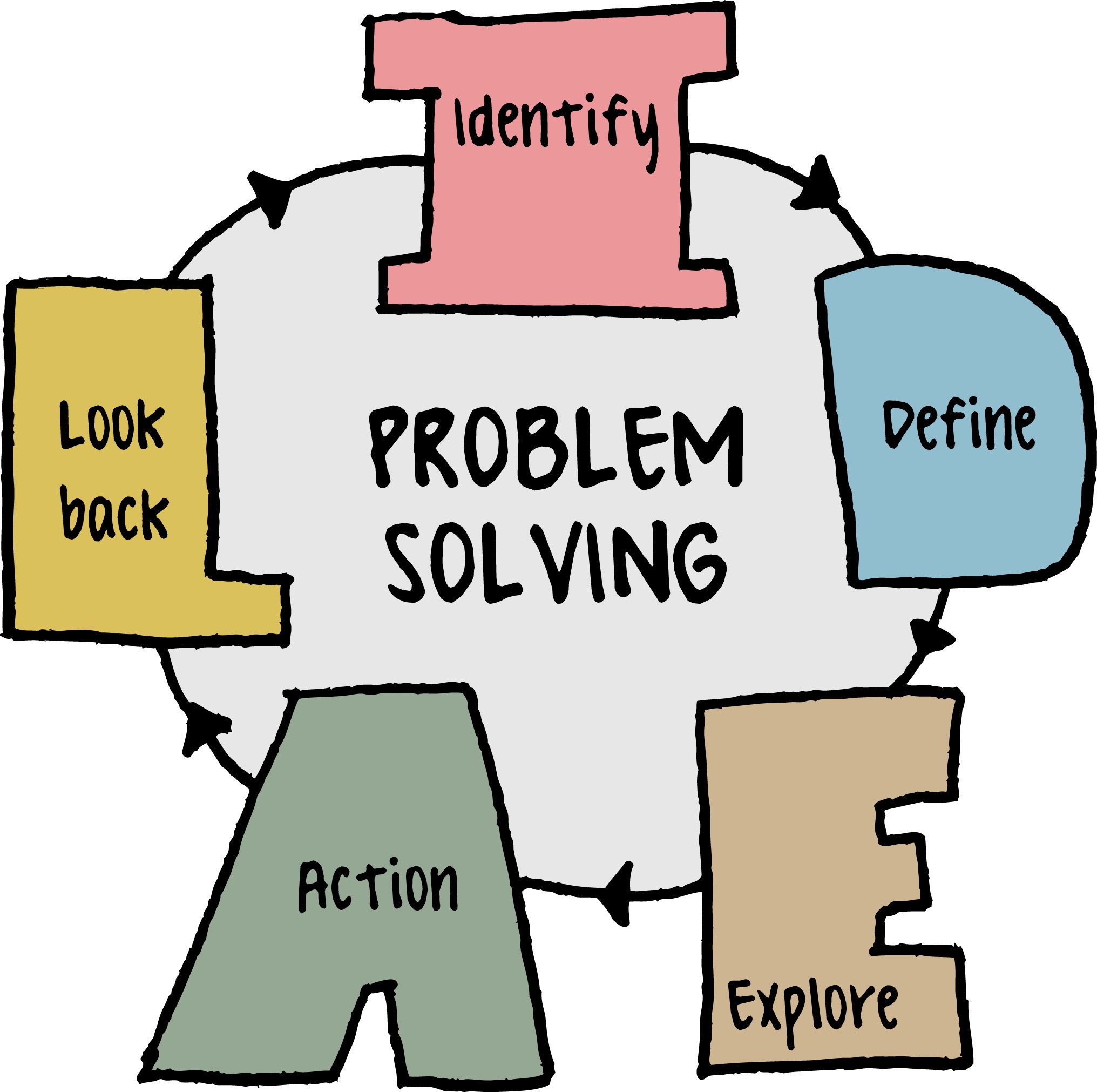
John Bransford (2014) developed the IDEAL problem solving model.
Identify the problems and opportunities
Define the problem and alternative goals
Explore possible solutions and strategies
Apply solutions by acting on strategies
Look at effects, evaluate and learn

So how did I implement this strategy?
The first step is to change your own mindset. As teachers we are so used to problem-solving - all day long we are faced with resolving hundreds of problems and this naturally flows over into solving the problems (and potential problems) our students face. 
We become adept at removing obstacles before they are encountered with the good intentions of smoothing the pathway to success. The flip side of this is that we grow students who lack opportunity to develop GRIT.


Grit: the power of passion and perseverance by Angela Lee Duckworth
(TED Published on May 9, 2013)


Rather than providing solutions, seek to provide (even better - co-construct with the students) strategies that they can turn to when faced with problems. We are great at doing this for maths problem solving, or decoding in reading, but we truly need it for all aspects of life.  

The art room is a fantastic place to develop this character trait in students. By building the opportunity to see what fails, into your lessons,  and taking those learnings into the next stages of design, students become comfortable with ambiguity and trialling ideas. They should seek to discover before converging on a singular plan. In my classroom we overtly identify this in 2 of our Design Thinking stages, ideation and  prototyping.

My Design Thinking Process wall with posters for Y4-6 students (9-11yrs)


 My Design Thinking Process wall with posters for Y1-3 students (5-8yrs)

During the Visualisation or Many Choices stage, students are given opportunity to (roughly) plan out multiple ideas on their chosen perspective. They get time to discuss all these ideas with other students, answer questions about their proposals, then receive and evaluate feedback. On the flip-side they get to observe and listen to the ideation of others and to develop their critical thinking skills when analysing and providing feedback on a variety of proposals. 

This also helps them become more open-minded to divergent thinking. I encourage students to seek feedback from someone other than their close friends, as the chances of it being more challenging and divergent to their way of thinking are higher and they could have a better chance of having their ideas challenged, pushed further or improved on. But I don't tell them who to go with. They self select at the level of divergence that they are comfortable with.

This short video shows Y2 students (5-6yrs) giving and receiving feedback. At times I modify slightly by asking the buddy to interpret the drawing before the artist explains it. This is based purely on the visual clues that the artist has included in their work. The purpose of this is to teach young artists about the power of non-verbal communication that art embodies. They learn how important it is to include detail and to aim for accuracy.

With older students it morphs into leaving more subtle clues so that the viewer can interpret the message without it being obvious. This links beautifully with the reading comprehension skill and sophisticated writing skill of inference.


** This video has been augmented with the CLIPS app to protect student identity.

Prototyping, the Test and Improve stage, can follow on, or run parallel with convergence - the narrowing down to a singular idea or plan for execution. I give students time to 'play' with media. to experiment with techniques and effects that they are envisioning for their plan. 

There is never going to be enough time in a curriculum to teach all the possible skills and techniques, for all the range of media available, at all the levels of development in a single class. By letting children play and experiment with what they are drawn to, they learn the things they personally want to find out. 
Because they have a vision that they developed and are strongly connected with, they will persevere, seek advice, trial and evaluate, experience what I call 'happy accidents' and may even return to their plan and modify it again. 


** This video has been augmented with the CLIPS app to protect student identity.

The amount of observational assessment that this 'play' segment yields is astounding, especially when combined with insights through student voice in the form of reflections.

Examples of student voice recorded on Seesaw, shared with parents.


In my next post, I will be exploring the learning/teaching technique of modelling and the impact it has on students' creativity levels.


Thank you for stopping by,
With love, Te Aroha
Timea
http://www.help-me-learn.com/
http://www.teacherspayteachers.com/Store/One-Teachers-Journey
http://www.teachersnotebook.com/shop/tkwillemse https://twitter.com/TimeaWillemse http://www.youtube.com/user/HelpMeLearnMaths
http://pinterest.com/tkwillemse/boards/
https://www.instagram.com/timea_oneteachersjourney/

Friday, 2 March 2018

Have you jumped in yet...or are you still peeking over the wall? Mindlab Activity 5

Reflection on the role of social online networks in my professional development (Rolfe, G., Freshwater, D., Jasper, M., 2001).

Figure 1. Wall of overwhelming Stuff. (Abbott, 2011)


What?

Recent research has identified some models of Professional Development to be less effective than others, e.g. one-day workshops or conferences not directly connected to a school’s academic programmes or teaching practises.

“Spontaneous, experiential, and unplanned” (Greenhow & Robelia, 2009, p. 122) informal learning driven by the urgent ‘just in time’ desires of teachers (Timperley, 2011) also seem to lack the impact of sustained professional learning with clear outcomes, driven by evidence and inquiry.

Contemporary ideas about teaching and learning endorse proactive participation of the learner in the learning process (Das Gupta, 1994). Therefore, it could be argued that social online tools fit within this practice. Blogging helps learners to express their ideas and collaborate with others, supporting both individual and social learning activities (Minocha & Kerawalla, 2010) as we become ‘Produsers - a hybrid of producer and user” (Bruns, 2007), and the boundary between consumers and creators of content is blurred. The greater the social capital (investment of time) of an individual or community, the greater the chance for improved practice and gain (Denzin & Lincoln, 2005, p. 21).

Figure 2. On-line Learning and Knowledge Building (Harasim, 2014)

My professional online networks include Facebook, Blogger, Twitter, Weebly, Pinterest, Instagram, Google+, Youtube, TeachersPayTeachers and Teachers Notebook which I use to connect with teachers from around the world.
My use of online social media changes with my role and interests in education.


So What?

Teacher-authors who write about observations in their own practise can be highly informative and motivating. The more you engage, the quicker you can weed out the weaker content and find deeply reflective practitioners willing to share ideas and findings, or expose you to diverging ideas and practices.

But how much influence does it have on student achievement? And how much quality control is there from the site moderators of the content being shared? Is this a place for poorly thought through ideas and responses not based in theory, nor considerate of impact on practise, (McLoughlin & Lee, 2010)? Perhaps that role of moderator falls on us - the knowledge community!
Figure 3. On-line Learning and Knowledge Building (Harasim, 2014)


Most educators look for 'affirmation of practice, advice on experiences within the classroom, new resources, and mentorship' in their online communities (Melhuish, K., 2013). Geographically separated or single subject teachers like me, working in isolation, can develop a collaborative, participatory model with others who were previously inaccessible, as I did this week to connect with Hamish (Betts, 2017), an art teacher from Singapore. Through our online profiles, I was able to contact and meet up in person with this expert in the field during a brief trip to New Zealand.

Online communities are comprised of mostly anonymous members connected by a communal interest and attending by choice. They range in experience, background and perspective which will challenge your preconceptions or provide support with an issue in your practice.


What Next?

Currently, I use my daily commute for independent online PD. A great way to tune in/front load knowledge is by listening to podcast channels recommended by my social networks.

My Podcast Channels (Willemse 2018).


I also engage with focused Google+, Twitter, and Facebook groups which trigger personal investigations or keep me informed about evolving conversations in my areas of interests.

My Twitter Feeds (Willemse 2018).


People engage to the level of their comfort or need but is 'lurking' a legitimate way of learning (Melhuish, K., 2013)? While this doesn't appear to contribute to community building, followership numbers boost the participation of active members, and learning through reading replicates print resource material from the past. But those that engaging in practice based discourse find this leads to more effective professional learning.

My Facebook Groups (Willemse 2018).


As connected 21C educators, we need to at least raise our heads over the walls of our classrooms and experience that cognitive dissonance to drive reflection on our practice. Melhuish, K.(2013) recognises the value of networking with educators beyond your own environment and vital for experiencing divergent thinking, that external voice is crucial to effective professional development (Ministry of Education, 2008; Timperley et al., 2007).

So jump in and enjoy the view!
Figure 4. Jump!!  (AnneCN, 2011).


REFERENCES:


Abbott S. (2011). Customer Crossroads. Wall of overwhelming Stuff image retrieved from http://www.customercrossroads.com/customercrossroads/2011/12/drinking-the-mouthwash-your-customers-are-overwhelmed.html

AnneCN (2011). Jump!! image retrieved from  https://www.flickr.com/photos/anne-cathrine_nyberg/5928692484/in/photostream/

Betts H. (2017). Creatively Hamish. Retrieved from http://www.creativelyhamish.com/#_blog


Bruns, A. (2007). 2nd ed. 'The Practices of News Blogging', in Bruns, A. and Jacobs, J. (eds)  Uses of Blogs. United States of America: Peter Lang.

Das Gupta, P. (1994). 'Images of childhood and theories of development', in Barnes, P. Personal, Social and Emotional Development in Children. United Kingdom: Blackwell/The Open University.

Denzin, N. K., & Lincoln, Y. S. (2005). The SAGE handbook of qualitative research (3rd ed.). United States of America: SAGE Publications Inc.

Greenhow, C., & Robelia, B. (2009). Informal learning and identity formation in online social networks. Learning, Media and Technology, 34(2), 119–140. doi:10.1080/17439880902923580
Heap, T.P. (2011).  An Investigation into the Blogging Practices of Academics and Researchers. Centre for Research in Education and Ed. Technology (CREET). The Open University, UK. Retrieved on 1 March 2108 from https://oro.open.ac.uk/35641/1/Thesis_tph37_final.pdf

Harasim, L. (2014). On-line Learning and Knowledge Building.  Retrieved on 1 March 2108 from https://lindaharasim.com/sfu-courses/cmns-453/part-2-topics-activities/https://lindaharasim.com/sfu-courses/cmns-453/part-2-topics-activities/

McLoughlin, C., & Lee, M. J. W. (2010). Developing an online community to promote engagement and professional learning for pre-service teachers using social software tools. Journal of Cases on Information Technology, 12(1), 17–30. doi:10.4018/jcit.2010010102
Melhuish, K.(2013). Online social networking and its impact on New Zealand educators’ professional learning. Master Thesis. The University of Waikato. Retrieved on 28 February, 2018 from http://researchcommons.waikato.ac.nz/bitstream/han…

Minocha, S. (2009a). 'A case study-based investigation of students’ experiences with
social software tools', New Review of Hypermedia and Multimedia, 15(3), pp.245-65

Minocha, S. & Kerawalla, L. (2010). 'University Students’ Self-motivated Blogging and Development of Study Skills and Research Skills', in Lee, M.J.W. and McLoughlin, C. (eds) Web 2.0-Based E-Learning: Applying Social Informatics for Tertiary Teaching, IGI Global.

NZ Education Council. (n.d.). What is social media . Retrieved 28 February, 2018 from http://teachersandsocialmedia.co.nz/what-social-me...

Rolfe et al.'s reflective model, (2001). Adapted from: Rolfe, G., Freshwater, D., Jasper, M. (2001) Critical reflection in nursing and the helping professions: a user's guide. Retrieved from https://my.cumbria.ac.uk/media/MyCumbria/Documents/ReflectiveModelRolfe.pdf

The Glossary of Education Reform (n.d.). Professional Development (2013). Retrieved on 1 March 2108 from https://www.edglossary.org/professional-development/

Timperley, H. S. (2011). Realising the power of professional learning. England: McGraw-Hill Education.

Weller, M. (2006). VLEs and the democratisation of e-learning' [online] http://slidesha.re/lguk6R
(accessed 1 March 2108 ).

With Love

Timea


Thank you for visiting,
http://www.help-me-learn.com/
http://www.teacherspayteachers.com/Store/One-Teachers-Journey
http://www.teachersnotebook.com/shop/tkwillemse
https://twitter.com/TimeaWillemse
http://www.youtube.com/user/HelpMeLearnMaths
http://pinterest.com/tkwillemse/boards/

Thursday, 2 November 2017

Post-graduate study with Mind Lab

Hello friends,

This has been a quiet year for blogging reflections because I have not only renovated my house from top to bottom but also signed up for post-graduate study with Mind Lab - nutty as a squirrel, some might say :)


The Mind Lab explains the course on their website as follows:

Postgraduate Certificate in Applied Practice (Digital & Collaborative Learning)
This is a Level 8, 60 credit programme that consists of the following four integrated course components, each worth 15 credits

1.Digital and Collaborative Learning in Context – 15 credits
2.Leadership in Digital and Collaborative Learning – 15 credits
3.Research and Community Informed Practice – 15 credits
4.Applied Practice in Context – 15 credits
For further details you can check out their website at http://themindlab.com/postgrad-studies/course-outlines/

https://pixabay.com/p-1968077/?no_redirect
I have just completed the first 16 weeks of face-to-face workshops and about to start the next 16 weeks which is taken on-line.


The first section included 4 assignment submissions and I will be posting those up as I reflect on my learning.

Hope you find some of these ideas useful or even challenging. Would love to hear about your perspective, thoughts or questions too so feel free to comment below.


With love as always


Thank you for visiting,
http://www.help-me-learn.com/
http://www.teacherspayteachers.com/Store/One-Teachers-Journey
http://www.teachersnotebook.com/shop/tkwillemse
https://twitter.com/TimeaWillemse
http://www.youtube.com/user/HelpMeLearnMaths

http://pinterest.com/tkwillemse/boards/

ShareThis