
Continuing with my summary of
Lai, E. R., Yarbro, J., DiCerbo, K., & de Geest, E. (2018). Skills for Today: What We Know about Teaching and Assessing Creativity. London: Pearson.
I pulled ideas from this research on ways to teach Creative Thinking in the classroom, and will share ways I have put this into practice over the next few posts. I hope you find something useful to apply in your lessons too.
Problem-Solving Training:
There is some compelling evidence for the positive impact of problem-solving training on creativity. Alfonso-Benlliure, Meléndez, and García-Ballesteros (2013) examined an intervention of six weekly, one-hour training sessions with PK-K. These sessions taught cognitive problem-solving processes including problem-finding, problem formulation, idea generation, and idea evaluation through games and exercises, including pretend and imaginative play.Students who received the intervention experienced gains in creativity which could be seen during drawing tasks when compared to the control group.
Kurtzberg and Reale (1999) developed a problem-solving intervention based on Torrance’s Future Problem-Solving (FPS) process (Torrance, 1978), for 8th Graders.
Individuals are presented with a “fuzzy situation” (i.e. an ill-defined, real-world problem that might be faced by future generations). This intervention focused on the problem-identification step, which involves brainstorming as many problem statements as possible that can be used to understand the fuzzy situation. Within the context of a physical science lesson on solar energy, students were taught strategies for brainstorming and were given lists of potential problem categories to help expand their list of problem statements.
Problem-identification skills were measured based on the students’ responses to other fuzzy situations. Students received scores based on
a) the number of problems identified,
b) number of problems identified that were relevant to the situation (fluency), and
c) number of different problem categories identified (flexibility).
Results indicated that the intervention positively impacted all four facets of problem-identification skills (process of identifying differences), when compared to the control.
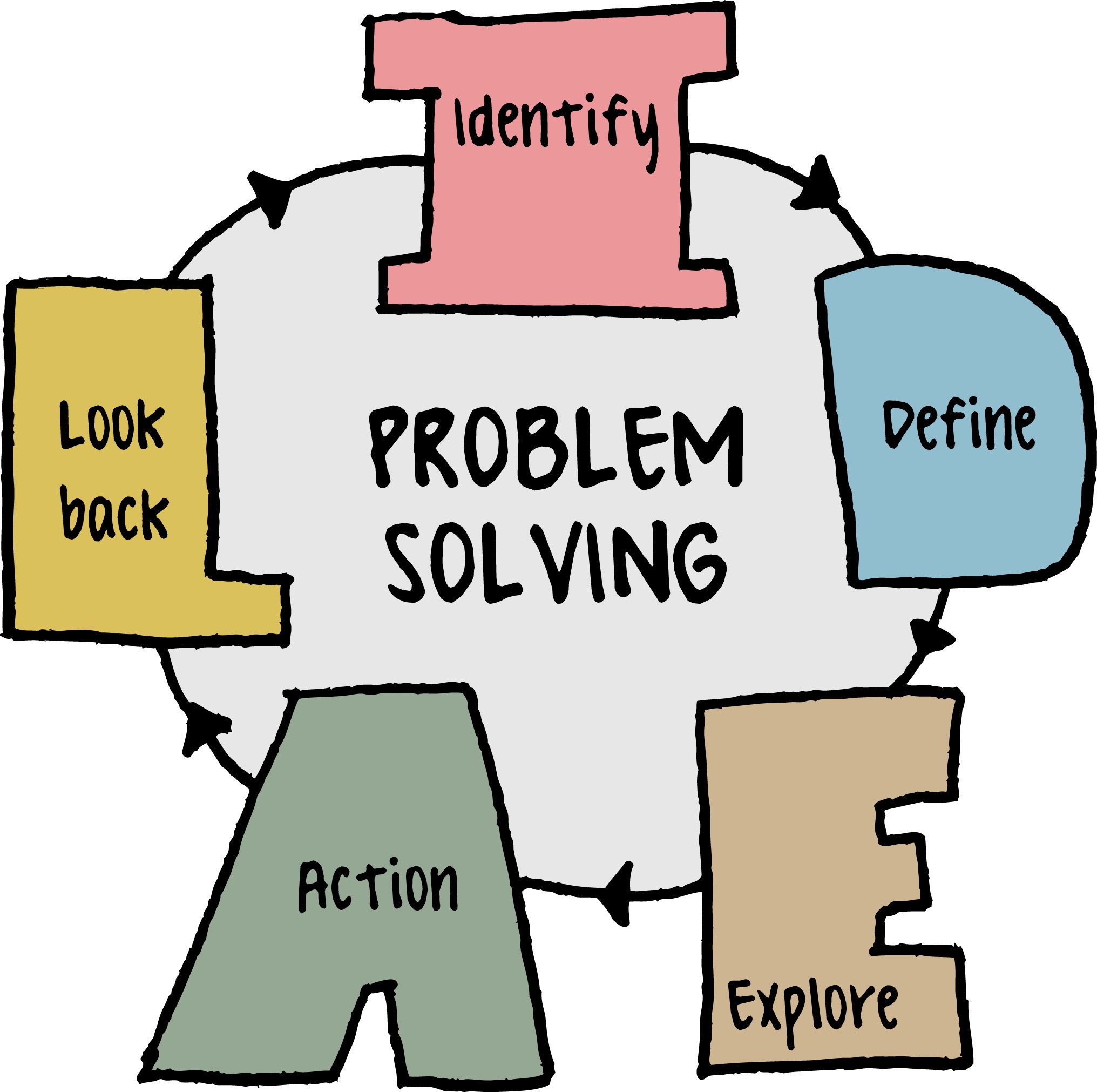 |
| John Bransford - ideal problem solving model (2104) |
John Bransford (2014) developed the IDEAL problem solving model.
Identify the problems and opportunities
Define the problem and alternative goals
Explore possible solutions and strategies
Apply solutions by acting on strategies
Look at effects, evaluate and learn
So how did I implement this strategy?
The first step is to change your own mindset. As teachers we are so used to problem-solving - all day long we are faced with resolving hundreds of problems and this naturally flows over into solving the problems (and potential problems) our students face.
We become adept at removing obstacles before they are encountered with the good intentions of smoothing the pathway to success. The flip side of this is that we grow students who lack opportunity to develop GRIT.
(TED Published on May 9, 2013)
Rather than providing solutions, seek to provide (even better - co-construct with the students) strategies that they can turn to when faced with problems. We are great at doing this for maths problem solving, or decoding in reading, but we truly need it for all aspects of life.
The art room is a fantastic place to develop this character trait in students. By building the opportunity to see what fails, into your lessons, and taking those learnings into the next stages of design, students become comfortable with ambiguity and trialling ideas. They should seek to discover before converging on a singular plan. In my classroom we overtly identify this in 2 of our Design Thinking stages, ideation and prototyping.
My Design Thinking Process wall with posters for Y4-6 students (9-11yrs)


My Design Thinking Process wall with posters for Y1-3 students (5-8yrs)

During the Visualisation or Many Choices stage, students are given opportunity to (roughly) plan out multiple ideas on their chosen perspective. They get time to discuss all these ideas with other students, answer questions about their proposals, then receive and evaluate feedback. On the flip-side they get to observe and listen to the ideation of others and to develop their critical thinking skills when analysing and providing feedback on a variety of proposals.
This also helps them become more open-minded to divergent thinking. I encourage students to seek feedback from someone other than their close friends, as the chances of it being more challenging and divergent to their way of thinking are higher and they could have a better chance of having their ideas challenged, pushed further or improved on. But I don't tell them who to go with. They self select at the level of divergence that they are comfortable with.
This short video shows Y2 students (5-6yrs) giving and receiving feedback. At times I modify slightly by asking the buddy to interpret the drawing before the artist explains it. This is based purely on the visual clues that the artist has included in their work. The purpose of this is to teach young artists about the power of non-verbal communication that art embodies. They learn how important it is to include detail and to aim for accuracy.
With older students it morphs into leaving more subtle clues so that the viewer can interpret the message without it being obvious. This links beautifully with the reading comprehension skill and sophisticated writing skill of inference.
** This video has been augmented with the CLIPS app to protect student identity.
Prototyping, the Test and Improve stage, can follow on, or run parallel with convergence - the narrowing down to a singular idea or plan for execution. I give students time to 'play' with media. to experiment with techniques and effects that they are envisioning for their plan.
There is never going to be enough time in a curriculum to teach all the possible skills and techniques, for all the range of media available, at all the levels of development in a single class. By letting children play and experiment with what they are drawn to, they learn the things they personally want to find out.
Because they have a vision that they developed and are strongly connected with, they will persevere, seek advice, trial and evaluate, experience what I call 'happy accidents' and may even return to their plan and modify it again.
** This video has been augmented with the CLIPS app to protect student identity.
The amount of observational assessment that this 'play' segment yields is astounding, especially when combined with insights through student voice in the form of reflections.
Examples of student voice recorded on Seesaw, shared with parents.


In my next post, I will be exploring the learning/teaching technique of modelling and the impact it has on students' creativity levels.
Thank you for stopping by,
With love, Te Aroha
Timea
http://www.help-me-learn.com/
http://www.teacherspayteachers.com/Store/One-Teachers-Journey
http://www.teachersnotebook.com/shop/tkwillemse https://twitter.com/TimeaWillemse http://www.youtube.com/user/HelpMeLearnMaths
http://pinterest.com/tkwillemse/boards/
https://www.instagram.com/timea_oneteachersjourney/

No comments:
Post a Comment