
Thimmesh C. (2014). TEDxUniversityofStThomas. Creativity in the classroom (in 5 minutes or less!).
Continuing my summary of Lai, E. R., Yarbro, J., DiCerbo, K., & de Geest, E. (2018). Skills for Today: What We Know about Teaching and Assessing Creativity. London: Pearson.
Today, I look at two curricula that the reading mentions, the Learn To Think (LTT) program and The DISCOVER project.
The Learn To Think (LTT) program (China - evaluated by Hu et al. (2013))
Was designed to develop thinking abilities (including aspects of creative thinking) in primary and secondary students in China.The program is based on the thinking-ability structure model, which includes:
- thinking content (mathematics, language and literature, science, society, art, other disciplines and daily life experience);
- thinking methods (observation, space cognition, comparison, classification, inductive and deductive reasoning, reorganization, brainstorming, transfer, questioning);
- thinking quality (profundity, flexibility, critical thinking, agility, and originality.
Hu et al. (2013) examined the impact of LTT on creative problem-solving within a scientific context for secondary-school students (aged 12+) who participated in LTT activities every two weeks over a two-year period.
Six months after the intervention concluded, creative problem-solving scores were significantly higher for students who received the LTT intervention, when compared to the control group.
These results indicate that the LTT program can positively impact the development of
scientific creativity in secondary-school students, with fairly long-lasting effects.
A list of Active Learning Strategies can be found here https://www.mcgill.ca/skillsets/files/skillsets/engaging_students_using_interactive_strategies_active_learning_strategies_handout-ltt_nov_2012_marcy_and_eva.pdf
The DISCOVER project (Maker, Jo and Muammar (2008)
A curriculum and teaching model organized around the following six principles:- Integrate multiple intelligences through self-selected product formats, available/accessible tools, and choices based on student interests and strengths;
- Pose a variety of types of problems and, at times, encourage students to design their own problems;
- Include collaborative and learner-centered environments with lots of flexibility;
- Organize content around broad-based, interdisciplinary themes;
- Model a variety of processes and give students opportunities to practice;
- Encourage students to develop varied products that reflect the diverse strengths, interests, and preferences of students.
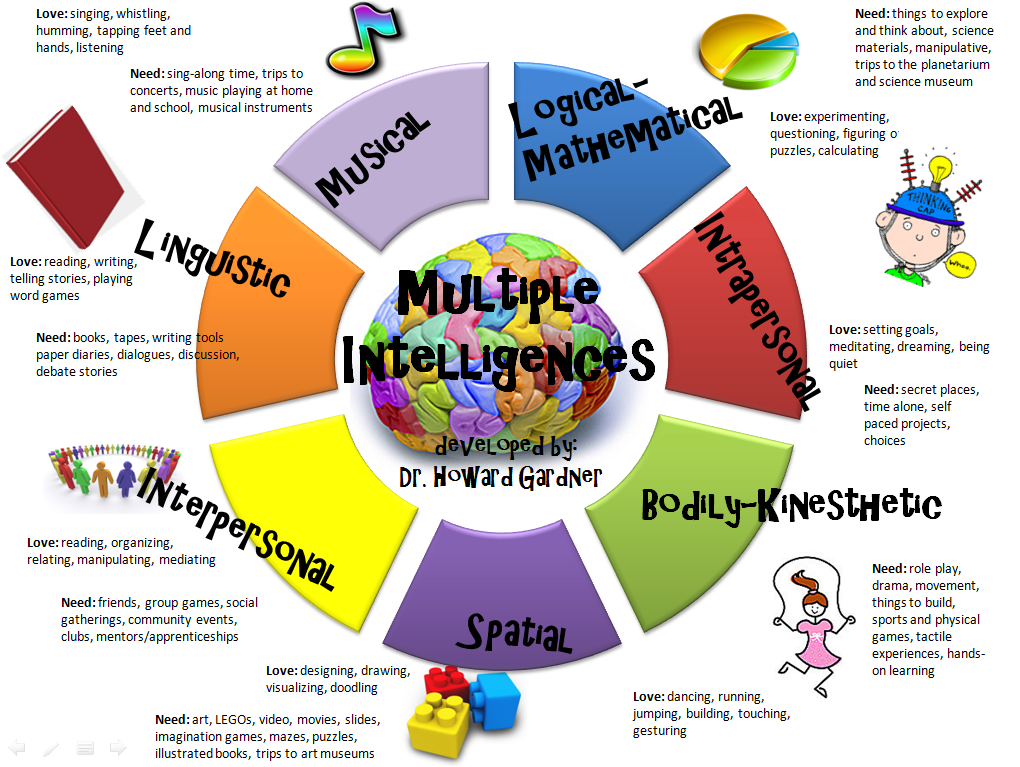 |
| https://pathwaystrainingandelearning.wordpress.com/2015/03/30/elearning-and-the-theory-of-multiple-intelligences/ |
Students demonstrated higher levels of creativity after being in a classroom where the DISCOVER curriculum was more fully implemented. This study provides evidence of an academic curriculum that can foster creativity without taking time away from academic content.
You can read more about Dr June Maker and the DISCOVER project here http://discover.arizona.edu/overview--uploaded.htm
Maker J. (2013). World Council for Gifted and Talented Children. 20th Biennial World Conference Keynote.
These two structured curricula identify some valuable points that make strong links for me to my school's curriculum (IB, PYP). I found it is easy to integrate the content and method aspects of 'thinking-ability' (LTT) and organize content around broad-based, interdisciplinary themes (Discover).
My modifications have been more based on posing the 'right' problems,and transitioning to a learner-centered and collaborative environment where varied work products are developed by students.
Last year I introduced media choice to Y3-4 students (ages 7-9). I offered offered media they were already familiar with, like acrylic paint, dye, oil pastels and wax coloured pencils. Then I introduced 3 new media - water colour paint, aqua pastels and aquarell pencils. I modelled these media and asked students experiment with them first before deciding on what to use for their personal exhibition work.
The students were excited about choosing their own content and media, and were highly engaged. I felt I was trying to introduce too much when added to management of resources and also striving to develop student independence. When students have a long gap between art terms, routines need to be re-established each year as our students rotate between art specialist each term (art, music, dance, drama).
The Y3 focus was Explorers (based on their classroom unit of inquiry) so we explored our favourite places around the school with our iPads and took personal photos to base our work on. I printed out each student's personal photo in colour for reference. A couple changed their minds during the drawing phase and selected another student's photo to work from. Here are examples of finished work product with the original student photo in the background and the student work over-layed.
 |
| Oil Pastels - Y3 cubby house |
 |
| Dye (liquid water colour) - walkway to gym |
 |
| Water colour paint - pylons (this student was inspired by a photography student's work from the year before) |
 |
| Acrylic paint - Y3 playground |
 |
| Aquarell pencils - the school pond |
 |
| Aquarell pencils - orchard blossoms |
 |
| Acrylic paint - water feature |
 |
| Wax pencils - school pond from bridge |
 |
| Dye - liquid water colours - blossom trees |
Y4 were looking at migration so they used iPads to research the beauty of New Zealand that makes it unique and a preferred destination for migrants. Combining aspects of their favourite images, each student compiled a unique landscape composition which they completed in a media of choice. Here are a few examples:
 |
| Aquarell pencils |
 |
| Oil pastels (L) and Water colour (R) |
 |
| Wax pencils |
 |
| Dye (L) and aquarell pencils (R) |
 |
| Oil on canvas (TL - student's own), Dye (TR), Oil pastels (BL), Aqua pastels (BR) |
Currently I am investigating ways to model a variety of processes and give students opportunities to practice, with the view of raising skill levels and deepening conceptual connections (thinking quality), without converging their thinking to my way being the 'right way'.
A method I am trialling at the moment with Y1-2 (ages 4-6) is to model skills in isolation, then share examples of student work (in progress and completed) demonstrating these skills, before students practice their own. Time is always a consideration when I only see students for a maximum of 18 hours a year. The obvious problem with this is that there is no time for students to try first and create a starting baseline to see where their skills are at. The skills component becomes a blanket instructional session which by its nature will only apply to about one third of the class and this will become evident in the quality of their personal pieces.
One could view it as a longitudinal learning process and be informed about student skills based on their previous year's work - if you teach them all year. With my school's current rotation system, this continuity is challenging.
With Love
Timea
Thank you for visiting,
http://www.help-me-learn.com/
http://www.teacherspayteachers.com/Store/One-Teachers-Journey
http://www.teachersnotebook.com/shop/tkwillemse
https://twitter.com/TimeaWillemse
http://www.youtube.com/user/HelpMeLearnMaths
http://pinterest.com/tkwillemse/boards/
http://www.teacherspayteachers.com/Store/One-Teachers-Journey
http://www.teachersnotebook.com/shop/tkwillemse
https://twitter.com/TimeaWillemse
http://www.youtube.com/user/HelpMeLearnMaths
http://pinterest.com/tkwillemse/boards/

Hey! This post couldn't be written any better! Reading this post reminds me of my good old room mate!
ReplyDeleteHe always kept chatting about this. I will forward this
write-up to him. Pretty sure he will have a good read.
Thank you for sharing!
Hello there! I could have sworn I've been to this website before but
ReplyDeleteafter browsing through some of the post I realized it's new to me.
Nonetheless, I'm definitely glad I found it and I'll be
bookmarking and checking back often!