
Of particular interest to me in my teaching area, was whether observational learning or exposure to creative models can enhance creativity, or limit it. For the past year, I have been struggling with this concept because my observations have shown that when a teacher models a completed product for students, they view that as the 'right answer' and may stop pushing the boundaries of their own original thinking. The quality and technical skills of students are however, much improved when they follow a teacher model / recipe lesson. So I was interested to read what the research says about this?
Bandura’s (1986) social learning theory suggests that individuals acquire new skills by watching the work of others. These modelling studies examine creativity through art and design learning.
Anderson and Yates (1999) taught artistic clay work to six-year-old students using social modelling and cognitive learning principles across a six-week period (ninety minutes of instruction per week - for me that would be 2 x 45 min periods). During the class, the teacher modelled techniques for working with clay, verbalizing her actions to give students a vocabulary for discussing clay-modelling processes. The class also involved frequent skill practice. The creative-work products (i.e. clay-work designs) of students receiving the modelling intervention were compared to those of students taught using traditional, non-directive curriculum practices. Results indicate that the modelling intervention had a positive impact on
- technical competence,
- decorative competence,
- aesthetic appeal, and
- three-dimension approximation.
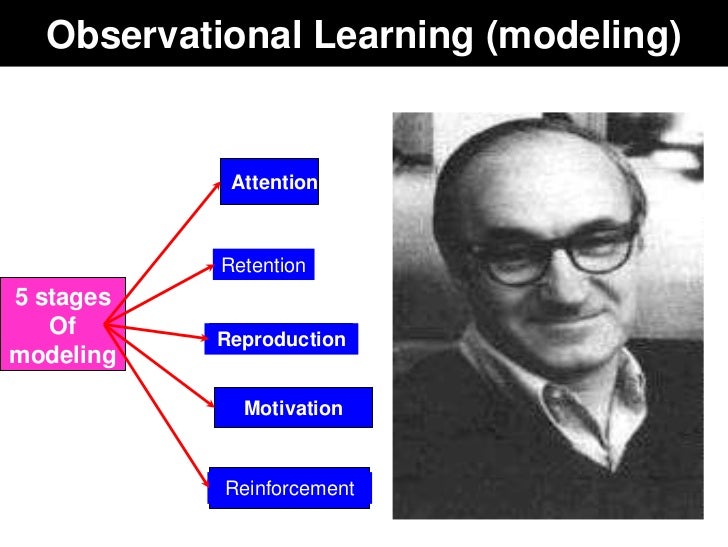 |
| Albert Bandura - Social Learning Theory |
I only have my students for 8-10 weeks a year so while I tried out this approach for the clay centre with students aged 4-6, I didn't have the extended time that is discussed in the research. But I do get students back each year so I view it as a longitudinal study where we can build on skills each year.
I rotated small groups through a clay workshop each period while the others created independently in drawing and modelling clay centres. We all made the identical object (a teacup and saucer) that covered technical skills of pounding, imprinting, stencil shape cutting, rolling spheres and snakes (coils), forming a pinch pot and attaching with the score, slip (magic water) and wiggle method. Children also solved for incidental problems around the ideal clay thickness for each element and the cracking of clay as it dries out.
The assessment this yielded for me included the students' listening and observation skills, technical application and following sequential instructions. It also gave me insight into how students approached this type of learning as I kept the groups small (7-8 students). These few photos show the work product of 5 and 6yr olds.
Teacups made with direct modelling, bisque fired and painted with tempera:


I followed up this round of clay lessons with an independent one where students were given a similar sized ball of clay and free reign to invent their own creation.
This lesson revealed deeper conceptual understandings, like generating original ideas, converging on one strong idea, technical skill retention, problem solving, independence, innovation and self-evaluation. It needs to be restated that students had been exploring with modelling clay as one of their independent centres.
Own choice:
 | ||||||
Stencil hearts layered into a cake and finger painted
|


Thank you for stopping by,
With love, Te Aroha
Timea
http://www.help-me-learn.com/
http://www.teacherspayteachers.com/Store/One-Teachers-Journey
http://www.teachersnotebook.com/shop/tkwillemse https://twitter.com/TimeaWillemse http://www.youtube.com/user/HelpMeLearnMaths
http://pinterest.com/tkwillemse/boards/
https://www.instagram.com/timea_oneteachersjourney/

No comments:
Post a Comment