As students completed their Kandinsky's Gardens paintings, I set out a printing learning center for them to experiment with more circles.
The center had:
- black paper strips (A3 triple-coated cartridge cut in half lengthwise). You need to provide white crayons for students to name their work :)
- plates of bright, pastel, metallic and fluro colours, and white
- a variety of circle shaped stamping objects, including ear buds, straws, lids, plastic rings, empty glue sticks, etc.
After a brief demonstration, paying particular attention to the work flow order, students were encouraged to experiment and print a composition of circles.
Once complete and hanging up to dry, students could go back and experiment further. Soon they were finding new ways to make marks with the stampers.
Super fun!! and a cool display too...love the variety and so vibrant :)
With all the provocation, exploration and skill practice done, the Y1s started on their individual art pieces - our Kandinsky's Gardens.
The students were working on a Social Studies unit back in class relating to public spaces we use and a colourful garden, where we could play, sounded like a great ideas for an art piece.
Exemplars of rolling hills images available on line
We sketched up our rolling hills and sky and applied 2 different paint finishes. The students started painting the hills first to build their skills for smooth painting, as this area had a line texture applied to the wet paint so messy painting was less noticeable :)
Next they completed the sky hues as smoothly as they could. This gave them a background of 'cool' tones.
A photo I took in Arrowtown, South Island NZ - love Autumn colours
To make their flowers / trees, we first painted our own Red and Gold papers, and applied the line textures to the Red where they were more visible.
Once they cut out all their multiple sized discs, they were left with a great maths challenge. They had to sort by size and colour and layer their discs to make their flowers.
To make this manageable, I gave each students a named envelope to store their discs in between visits to the Art Space, and stored each class set of envelopes separately.
Great fine-motor development for little hands
The final step was to compose their discs within their painted landscapes and add branches or stems to their painting and voila! - Kandinsky's Gardens.
This 74 page step-by-step art lesson includes all instructions for Kandinsky's Garden as well as the materials for the provocation activities written about in previous posts. It can be purchased from
I love introducing children to amazing and talented artists and I count Kandinsky as one of those unique individuals that I could spend ages exploring.
Once we started to take a closer look at the element of line with my little-ies, we explored his painting - Composition VIII...
Kandinsky regarded Composition 8 as the high point of his postwar achievement. In this work circles, triangles, and linear elements create a surface of interacting geometric forms. The importance of circles in this painting foreshadows the dominant role they would play in many subsequent works. Solomon Guggenheim purchased Composition 8, the first of more than 150 works by the artist to enter the Museum's collection.
With younger children, we worked as a group, finding many different lines types in this painting. For older students, I made them each their own copy for their art journal and asked them to label the ones they could identify, then we shared our findings as a class.
We followed this up with this journal age about lines (note 2 different levels)...
After exploring the lines types individually, students were challenged to draw a picture in the box completely composed of the line types listed above.
They came up with some great ideas :)
With older students we went even further and looked at how line types are used in cultural patterns in a specific way to define their unique and identifiable characteristics.
Here I projected up examples of Kowhaiwhai patterns (NZ Maori) and also gave each student their own copy.
We used different colours as we built up the seemingly complex patterns from the main elements through to the minor.
This exploration of cultural line lead into a unit on sea creatures with Y3 students which I will post more on later ...
After our small group discussions about this painting (see this previous post) I spent some time sharing with the students about Kandinsky and his life experiences. This can be run as a hot-seat activity (a common drama element), where the expert on a famous person (in this case, me) can dress in costume to represent the character that they are taking the role of. Students can then ask you questions as if interviewing the actual person, trying to get to know more about them.
Next I printed a small colour image for each student and we took some time to individually explore this painting in our sketchbooks by having a go at reproducing in to a larger scale. I found it fascinating to see what different elements stood out for each student and which elements they completely missed. A great activity to promote skills of observation, discrimination, comparison and contrast.
The following resource pages form part of this 74 page art unit available on line from TPT(click here) and TNB(click here). These art journal pages come in 2 levels - for younger and older students:
GOING FURTHER with The Dot by Peter Reynolds
If you have already read my previous post, you will have seen the video of this great little book. With my students, we painted our own 'Dots' and compiled them into a colourful classroom mural.
Here are some samples from Y1 (ages 4-5) using water soluble dye:
Here are some samples from Y3 (ages 6-8) with tempera pressed block paint:
Together as a stunning mural (3 x Y1 classes and 3 x Y3 classes):
I have published the step-by-step instructions to this activity as part of this 68 page art unit available on line from TPT(click here) and TNB(click here):
There is also a phenomenon called CIRCLE PAINTING that is worth investigating further if you are interested.
With love as always :)
Provocations for art lessons about Kandinsky and the element of line:
With my first group of art students ever (in my role as an art specialist teacher), I had a strong gut feeling that before any art could happen, I needed to win the trust of my students. Not just in me as their guide through this new specialist subject area, but also in themselves as artists. For this reason, I went away from starting with representational art and turned instead to Wassily Kandinsky.
In brief, Wassily Wassilyevich Kandinsky was an influential Russian painter and art theorist. He is credited with painting one of the first purely abstract works. Born in Moscow in 1866, Kandinsky grew up in Odessa, then spent his working life between, Germany, France and Russia painting in the styles of Expressionism, German Expressionism, Modern art, Der Blaue Reiter and Abstract art .
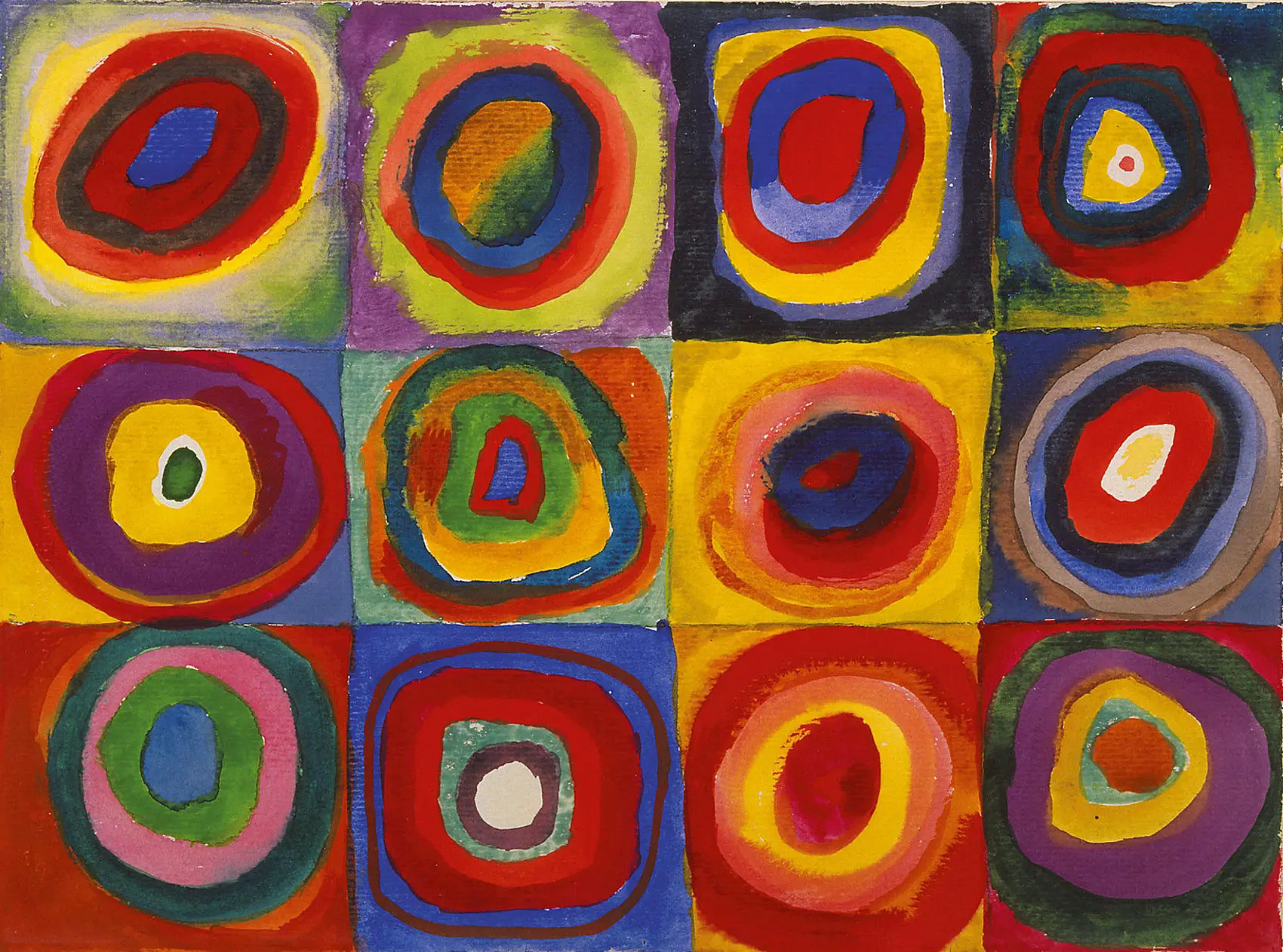
Color Study. Squares with Concentric Circles. 1913
The first questions I posed to my students during our initial 'greet and meet' session was as follows:
These were mostly 5 year olds and it was hard work getting even this much from them :)
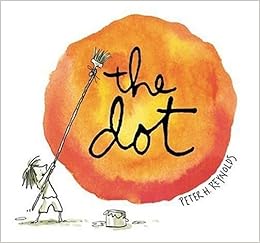
Some of the provocation that I used during this unit included this fabulous little book called The Dot by Peter Reynolds.
All the students from ages 4-7 loved the message in the story and this video link will give you a good idea as to why it appeals so...
We followed this up with a mini practical activity that I will write about in my next post 'Going Further'.
Another provocation we used was to gather in small groups and view a laminated print of the following work by our artist model:
Without any lead in, students were asked to look at this painting in groups of 3-4 and imagine what they thought the painting might be about. This was a very successful activity as students started to take risks with their ideas once they realised that there were no right or wrong answers, we were aiming to push the limits of our imagination and using our skills of inference, linking with prior knowledge (sound like essential reading skills to anyone?)
We had a variety of responses from the more common ones of bubbles and planets to baby birds, eyes and even marbles. Older students/more mature thinkers could start on developing a narrative that fits with this painting.
I followed up with an independent activity that I will write about in my next post 'Going Further'
Later on, we also looked at this paining by Kandinsky:
Composition VIII
This provocation came later into the unit once we were ready to explore line types. Initially I asked students to draw line types that they already knew, onto the whiteboard and once we had a few, we tried to come up with sensible names for these. With this painting, students were asked to identify the lines we already knew before finding new ones we hadn't yet named, to add to their collection.
In my next post I'll write about how we delved more deeply into these concepts. Hope you can return to read more :)